You’d think sitting down would be the one time your balance doesn’t matter. You’re not walking. You’re not turning your head. You’re not navigating a busy environment. You’re just sitting.
And yet, there it is — a rocking sensation. A subtle sway. A feeling that your body isn’t quite stable even though you’re completely still. The chair is solid. The floor isn’t moving. But something inside you is.
This was one of the symptoms that confused me most early on. I could understand feeling off-balance while walking through a busy store. But feeling off-balance while sitting in a library? That didn’t make sense — until I started paying attention to what was actually going on.
In this post:
- What sitting-still imbalance actually feels like
- Why it happens even without movement
- The chair height discovery that changed things
- What environments make it worse
- Simple adjustments that help
Short version for brain fog readers: Your balance system doesn’t turn off when you sit down. If your vestibular system is sensitized, it keeps processing — and environmental factors like chair height, lighting, and sensory input can trigger imbalance even while sitting. Grounding your feet firmly on the floor makes a real difference.
What it actually feels like
The sensation isn’t dramatic. It’s not like the room is spinning or you’re about to fall. It’s subtler and in some ways more unsettling because of that.
For me, it shows up as a gentle rocking or swaying — like being on a boat that’s barely moving. Sometimes it’s a tilting feeling, as if one side of my body is slightly heavier than the other. Other times it’s just a general unsteadiness — a sense that my body isn’t fully anchored even though I’m sitting on a solid surface.
The best way I can describe it is this: my body wasn’t moving — but my brain was interpreting it as movement. That’s the core of what makes this so disorienting. It’s not a balance problem in the traditional sense. It’s a processing problem — your brain is misreading stillness as motion.
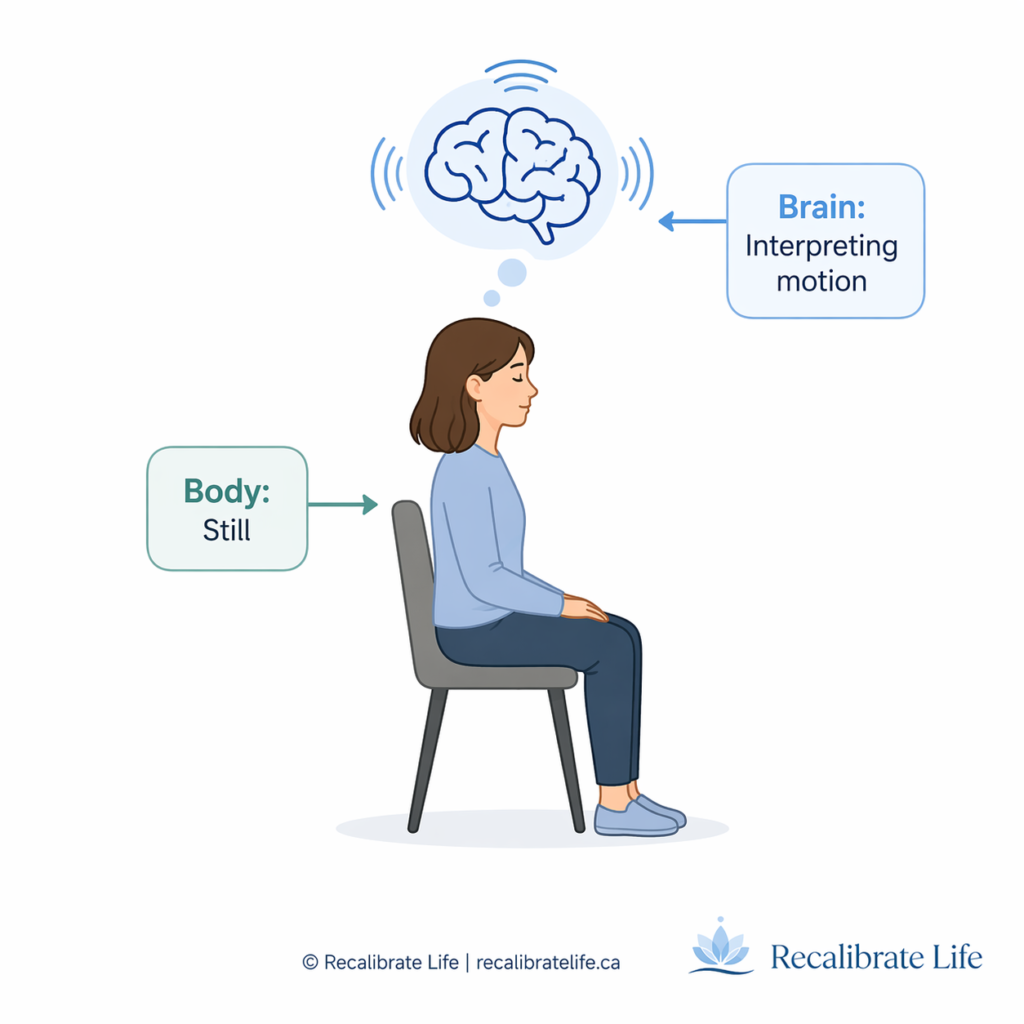
The intensity depends on the day and how my system is doing overall. On good baseline days, I might barely notice it. On days when my flare-ups have been active, it’s unmistakable — distracting enough that focusing on a conversation or reading becomes genuinely difficult.
What makes it confusing is that it happens when you’re doing nothing. You’re not moving. There’s no obvious trigger in that moment. So you start questioning whether it’s real or whether you’re just hyperaware of your body. It’s real. And there’s a reason it happens.
Why your balance system doesn’t turn off when you sit
Most people assume balance only matters when you’re standing or walking. But your vestibular system is always active — it processes spatial orientation constantly, regardless of whether you’re moving.
When you sit, your brain is still receiving signals from three sources: your inner ear (vestibular input), your eyes (visual input), and your body’s position sensors (proprioceptive input). In a healthy system, these signals agree and you feel stable without thinking about it.
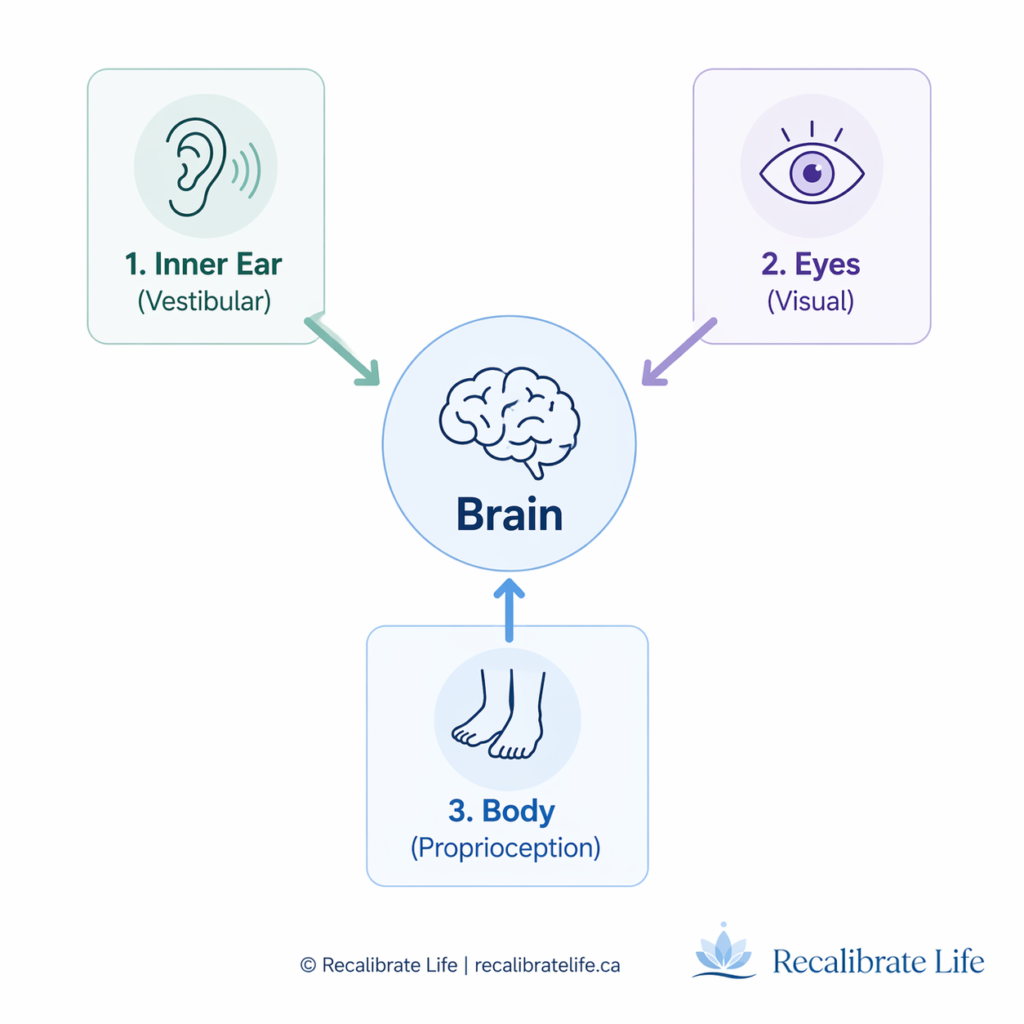
With vestibular migraine, those signals don’t always agree. Your inner ear might be sending slightly inaccurate information. Your brain is working harder to reconcile inputs that don’t match. And anything that adds complexity to that processing — bright lights, background noise, visual motion around you, even the height of your chair — can tip the balance from “managing” to “struggling.”
Sitting removes movement as a variable, but it doesn’t remove the environmental inputs your brain is still processing. And when those inputs are high — like in a library with fluorescent lighting or an office with ambient noise — your system can still get overloaded even though your body is perfectly still.
The chair height discovery
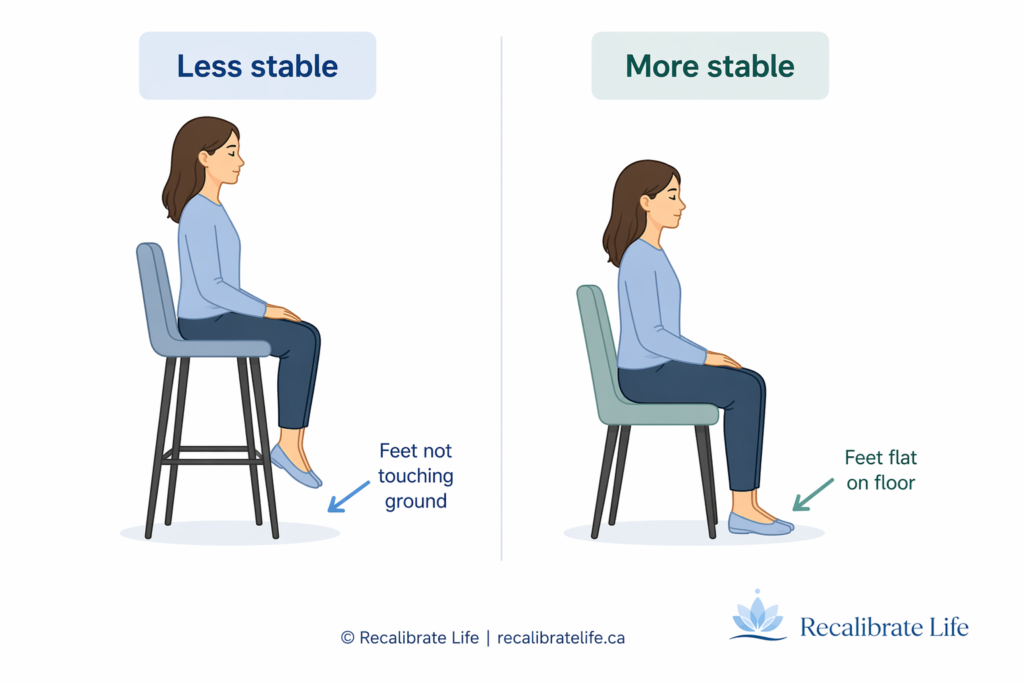
This was one of the most unexpected things I noticed, and it made a real difference once I understood it.
I used to sit on high chairs — the kind where your feet don’t fully reach the ground, or they’re resting lightly without firm contact. In the library, at certain desks, at various environments — high seating was common. And I consistently felt worse in those chairs.
When I switched to regular-height chairs where my feet were flat on the ground, the imbalance reduced noticeably. Not dramatically — but enough to feel the difference. I also noticed that it wasn’t just about feet touching the floor — it mattered that my knees were at a comfortable angle, not too high or too low, and that my posture felt natural rather than forced.
If my feet aren’t grounded properly, the imbalance feels worse — like my body doesn’t know where it is in space.
The reason makes sense once you think about it. When your vestibular system is struggling, your brain relies more heavily on proprioceptive feedback — the physical sense of where your body is in space. Your feet on the ground provide one of the strongest proprioceptive signals available. They tell your brain: you are here, the ground is here, you are stable.
When your feet are dangling or barely touching the floor, that signal weakens. Your brain loses one of its anchoring inputs, and the imbalance increases because there’s less reliable data to compensate for the vestibular signals that aren’t working properly.
This is the same principle behind gripping a shopping cart in a store. Any additional point of firm physical contact — feet on the ground, hands on a solid surface, back firmly against a chair — gives your brain more reliable feedback to work with. When your balance system is compromised, these grounding inputs become essential, not optional.
Where it’s worse and where it’s better
Not all sitting environments are equal. Through experience, I’ve learned which setups help and which ones make things harder.
The couch at home is usually the most comfortable in terms of relaxation — familiar environment, controlled lighting, minimal noise. But I’ve also noticed that very soft, sinking surfaces can actually make the imbalance feeling more noticeable in some situations. When the surface is too soft, your body gets less clear feedback about where it is in space. The softer the surface, the less proprioceptive data your brain receives. So while a couch feels comfortable, a firmer seat sometimes provides better stability signals.
A dining chair at home is fine as long as my feet are touching the ground. The key is that firm contact with the floor. Standard height, stable surface, familiar environment — my system handles it without much difficulty.
An office chair at home works because I’ve adjusted it to my height and I control the surrounding environment — screen brightness, lighting, noise level. It’s manageable.
Outside environments are where things get harder. A library chair, a waiting room seat, a chair at someone else’s office — these come with variables I can’t control. The lighting might be fluorescent. There might be background noise or people moving in my peripheral vision. The chair might be too high. All of these add processing load to a system that’s already sensitive.
The pattern is clear: controlled environments with grounding contact feel manageable. Uncontrolled environments with high sensory input and poor grounding feel worse. It’s not about the sitting itself — it’s about everything else your brain is processing while you sit.
I also noticed that the inconsistency applies here too. The same library chair could feel fine one day and uncomfortable the next. The difference always came down to what my system was already carrying — sleep quality, stress level, food, previous exposure. By the time I sat down, my tolerance for that session was already partially determined.
What helps when it happens
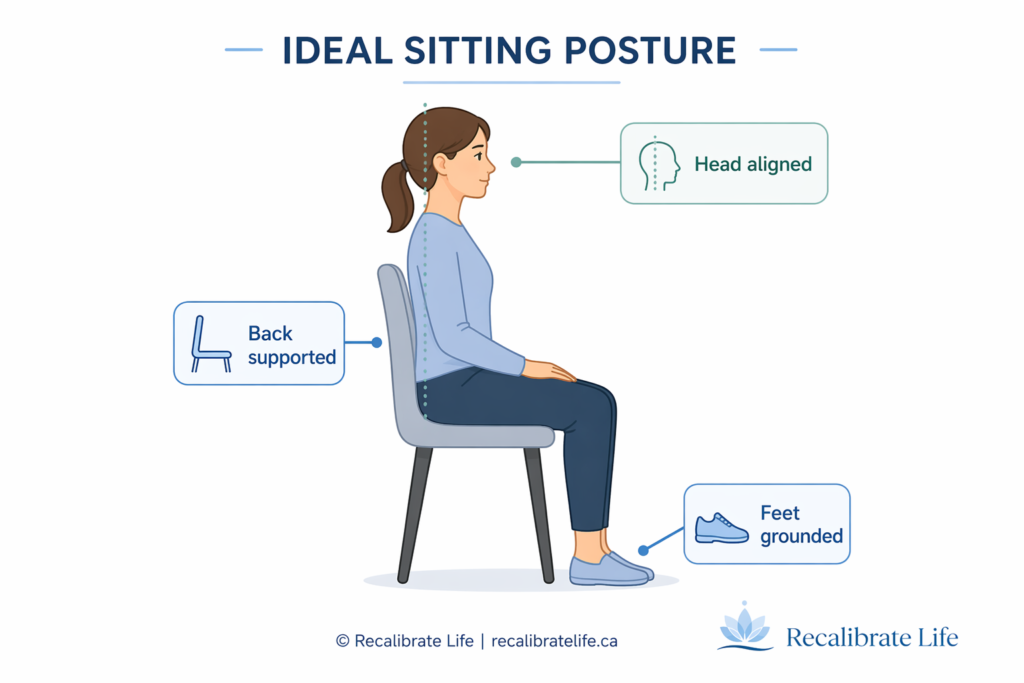
These are small adjustments, but they make a genuine difference when your system is sensitive.
Plant your feet firmly on the floor. This is the single most effective thing I’ve found. Flat feet, solid contact, conscious awareness of the ground beneath you. If the chair is too high, find a lower one or rest your feet on something solid. That proprioceptive signal from your feet to your brain is a powerful stabilizer.
Sit back fully with upright posture. Let your back make contact with the backrest and keep your spine relatively straight with your head aligned. More physical contact points mean more feedback for your brain. Perching on the edge of a seat removes one of those contact points and makes imbalance more likely. An upright, aligned posture reduces that “floating” or “detached” feeling significantly compared to slouching or leaning.
Deep breathing. When the rocking or swaying starts while sitting, slow, deliberate breathing helps settle the nervous system. It reduces the overall activation level, which gives your vestibular system slightly more capacity to process without overloading. A few minutes of focused breathing can noticeably reduce the sensation.
Don’t over-focus on it. This one took me time to learn. When the imbalance starts while sitting, the instinct is to hyper-focus on the sensation — analyzing it, measuring it, wondering if it’s getting worse. But that focused attention actually amplifies it. When I catch myself monitoring every subtle shift, I consciously redirect my attention to something else — my breath, what I’m reading, the task in front of me. The imbalance doesn’t disappear, but it fades to the background when I stop staring at it.
Get up and move briefly. This might sound counterintuitive — you’re sitting because standing feels harder. But sometimes sitting still actually makes the processing problem worse because your brain is stuck in a loop of mismatched signals. Standing up and walking for even 30 seconds can reset the system. The movement gives your brain fresh, clear vestibular input that can break the stagnant misfire. I’ve found that a brief walk — even just around the room — often settles things more effectively than sitting and waiting it out.
Stay hydrated. Dehydration makes everything worse — including balance. I keep water with me constantly, and I notice that the sitting imbalance is more pronounced when I haven’t been drinking enough.
Wear a cap in outside environments. This might sound unusual, but it works for me. When I’m in an environment with bright or distracting lighting — a library, a waiting room, anywhere with overhead fluorescents — wearing a cap reduces the amount of light and visual distraction reaching my eyes. It narrows my visual field slightly, which reduces the processing load on my system. It’s a simple tool that makes overstimulating environments a little more manageable.
Choose your seat intentionally. When you have a choice, pick the chair that gives you the most grounding — lowest height with feet flat on floor, back support, and ideally facing away from the busiest part of the room. Reducing the visual motion in your peripheral vision helps your brain focus on stability rather than tracking movement around you.
It’s not in your head — it’s in your processing
If you feel off-balance while sitting still and you’ve been wondering whether you’re imagining it — you’re not. Feeling off while sitting still isn’t a balance problem in the traditional sense — it’s a processing problem. Your brain is misinterpreting stillness as motion because your vestibular system is sending unreliable signals.
Your vestibular system processes balance continuously, not just when you’re moving. And when that system is sensitized, even a still, seated position can feel unstable if the environmental inputs are high enough or the grounding feedback is insufficient.
The good news is that the same principles that help with other vestibular challenges apply here too. Grounding, controlled exposure, managing environmental inputs, and gradually building tolerance. It’s the same recalibration process — just applied to a different situation.
Your balance might feel off even when you’re sitting still. But understanding why it happens gives you the tools to manage it.
If you’re tracking your triggers and symptoms across different environments, my free Vestibular Trigger Checklist covers food, light, sound, sleep, stress, and environmental triggers. Drop your email and I’ll send it to you.
Related posts: