This is the question that quietly eats at you.
You’re standing in a bright, busy store and your heart starts racing. Your breathing speeds up. You feel off-balance and slightly panicked. And you wonder: is this my vestibular condition acting up — or am I just anxious?
People around you can’t see anything wrong. From the outside, you look fine. And because you look fine, the assumption is easy: maybe it’s stress. Maybe it’s anxiety. Maybe you’re overthinking it.
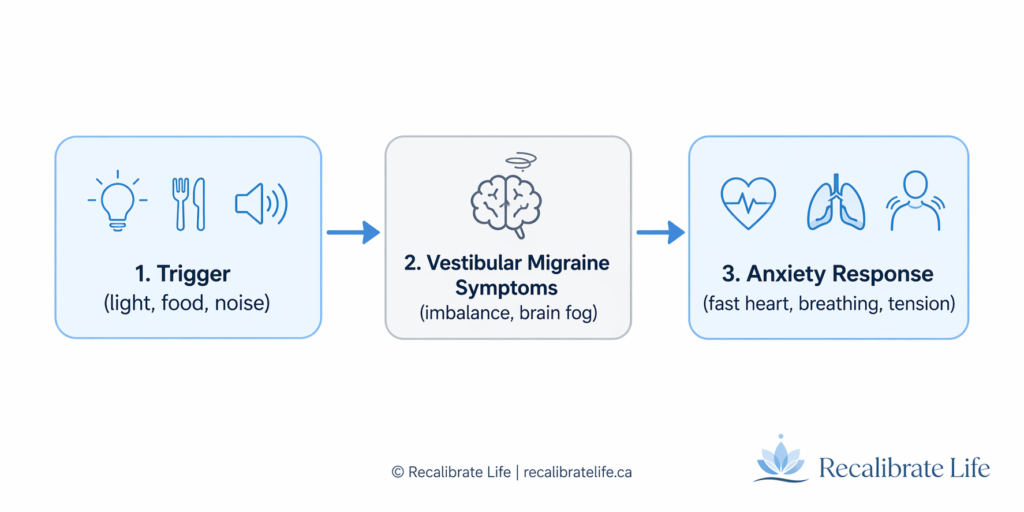
I spent a long time wondering the same thing. Until I noticed something that changed how I understood everything: the dizziness always came first. The anxiety came after.
That distinction matters more than most people realize. And if you’re caught between these two explanations — is it VM or is it anxiety — this post will help you understand what’s actually happening.
In this post:
- How to tell anxiety and VM apart
- The feedback loop that makes it confusing
- Why “just anxiety” is almost never the full answer
- How to break the cycle
- What I wish people around me understood
Short version for brain fog readers: If your dizziness is triggered by food, light, sound, or head movements — that’s not anxiety. That’s vestibular migraine. Anxiety often follows VM symptoms, not the other way around. They feed each other in a loop, but VM is typically the starting point. Understanding that changes how you manage both.
How anxiety and VM feel different in your body
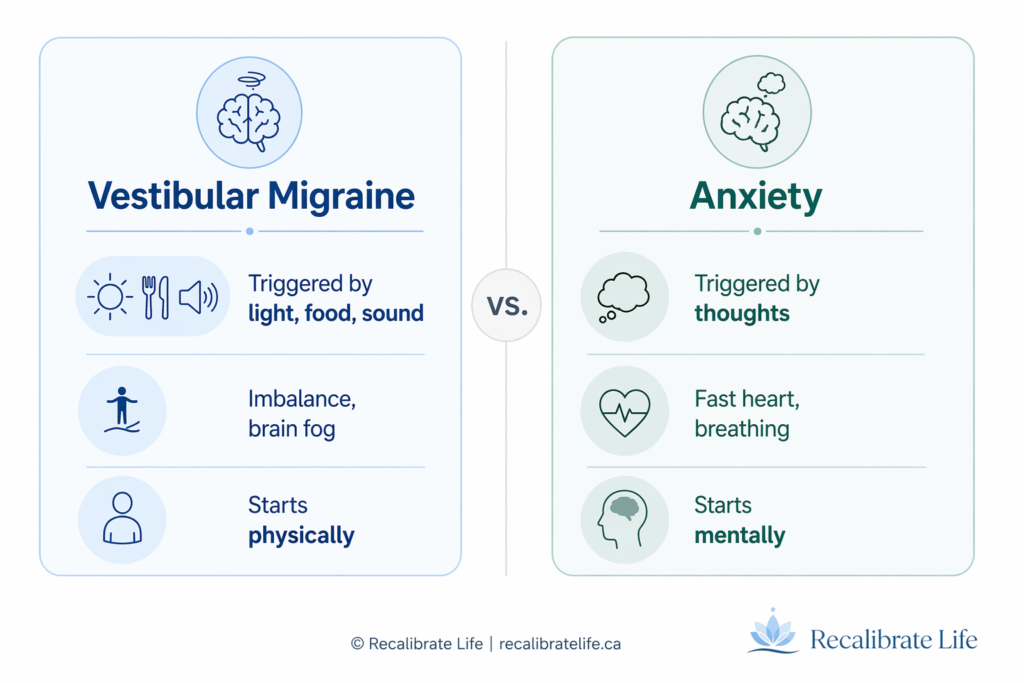
On the surface, anxiety and vestibular migraine share symptoms — dizziness, racing heart, feeling off-balance, difficulty thinking clearly. That overlap is exactly why they get confused so often, both by patients and sometimes by the people around them.
But when I started paying close attention to the order things happened in my body, a clear pattern emerged.
With vestibular migraine, the physical symptoms start first. I walk into a bright environment or eat a trigger food, and the imbalance begins. The brain fog thickens. My head feels heavy. My balance feels uncertain. These are neurological symptoms — my vestibular system reacting to a specific trigger.
Then the anxiety follows. Once I feel the imbalance starting, my brain jumps to: “What if this gets worse? What if I can’t get through this? What if I have to leave?” My heart rate increases. My breathing speeds up. My body tenses. These are anxiety responses — my nervous system reacting to the vestibular symptoms that already started.
The critical difference: VM is triggered by external inputs — food, light, sound, head movements. Anxiety is triggered by the experience of feeling those symptoms. One is a neurological response to a specific stimulus. The other is an emotional response to feeling off-balance.
If it were purely anxiety, it wouldn’t matter what I ate. It wouldn’t matter whether the lights were fluorescent or natural. It wouldn’t react to specific head movements. But it does — consistently and predictably. That’s not anxiety creating symptoms. That’s vestibular migraine creating symptoms, and anxiety amplifying them.
The feedback loop that makes everything confusing
The reason it’s so hard to separate anxiety from VM is that they don’t stay separate. They create a feedback loop that blurs the line between them.
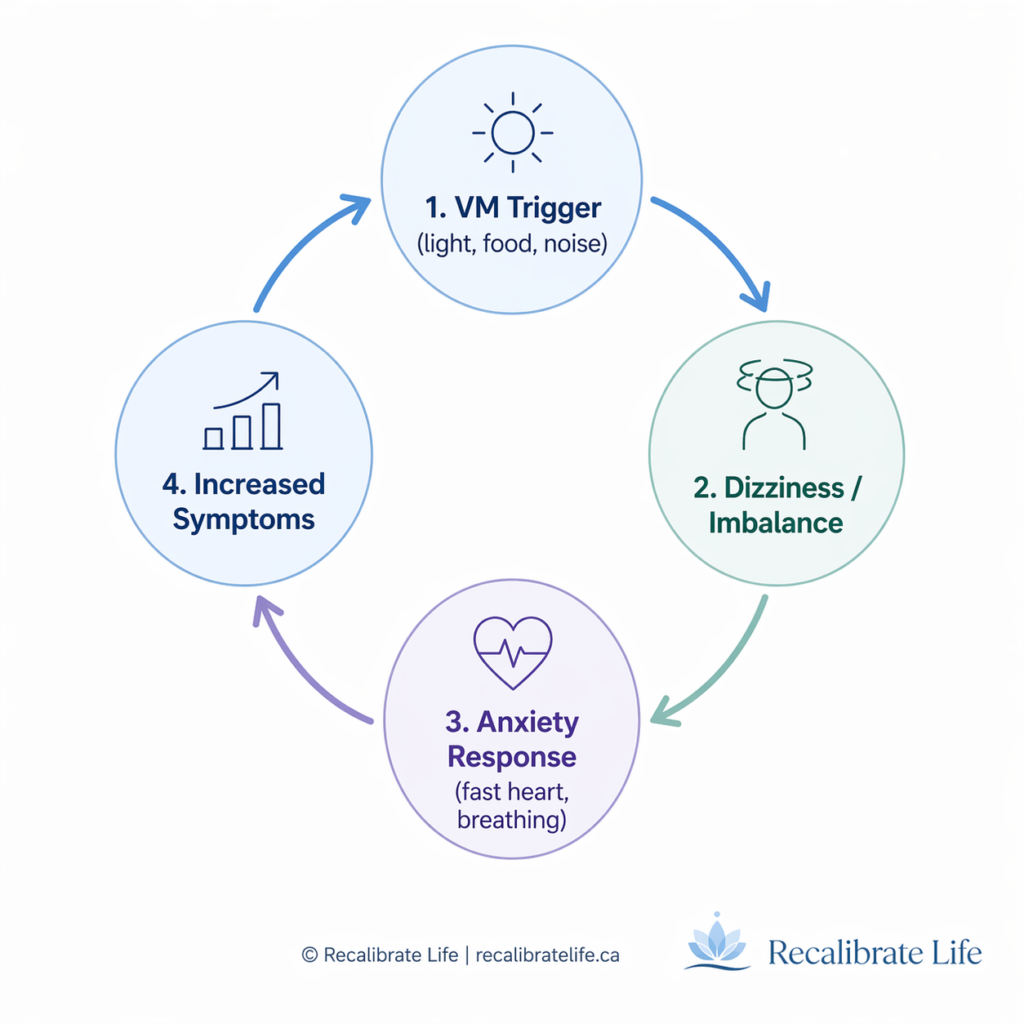
Here’s how it plays out in real life:
Step 1: You enter an environment with VM triggers — bright lights, noise, crowds, or you eat a trigger food. Your vestibular system activates.
Step 2: Symptoms appear. Imbalance, brain fog, heavy head. These are neurological — your balance system is struggling with the input.
Step 3: Your brain registers the symptoms and anxiety kicks in. “What if it gets worse?” Your heart rate rises. Breathing speeds up. Muscles tense.
Step 4: The anxiety response adds more load to your already struggling system. The tension, the faster breathing, the heightened alertness — all of this makes the dizziness and imbalance feel worse.
Step 5: The worsened symptoms create more anxiety, which creates more symptoms. The loop feeds itself.
From the outside — and even from the inside — it becomes impossible to tell where VM ends and anxiety begins. They merge into one overwhelming experience. And that’s why it’s so easy for someone to look at you and say “you seem anxious” — because by that point, you are. But the anxiety isn’t the root cause. It’s the response.
Why “just anxiety” is almost never the full answer
If you’ve been told — by anyone — that what you’re experiencing is “just anxiety,” I want you to consider this:
Anxiety doesn’t react to ketchup. It doesn’t spike because you ate processed bread. It doesn’t get worse under fluorescent lights specifically. It doesn’t improve with the Epley maneuver. It doesn’t correlate with sleep consistency in the specific way vestibular migraine does.
If your symptoms have clear, repeatable triggers — if certain foods consistently make you dizzy, if bright environments reliably make you feel off-balance, if poor sleep predictably leads to worse days — that’s a neurological pattern, not an anxiety pattern.
That’s not to say anxiety isn’t present. It almost certainly is. Living with a condition that makes your world feel unstable is inherently anxiety-producing. But the anxiety is a layer on top of the vestibular condition — not the foundation underneath it.
This distinction matters because the management approach is different. If you treat it as pure anxiety, you might try to think your way out of it, push through it, or dismiss the physical triggers that are actually driving the symptoms. If you understand it as VM with anxiety layered on top, you address both: manage the triggers that activate the vestibular symptoms, and manage the anxiety response that amplifies them.
The anticipation problem
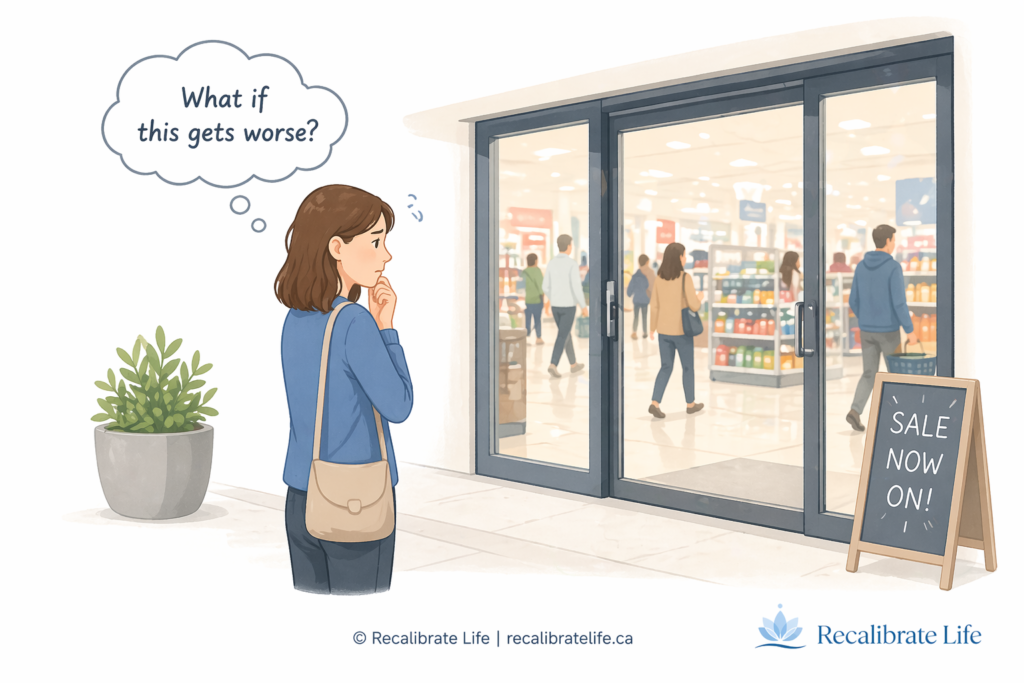
One thing that develops over time is anticipatory anxiety — your body starts reacting before you’re even in the triggering environment.
Standing in a parking lot before walking into a store, my heart rate would already be elevated. The “what if” thoughts would start before I reached the door. My body had learned from past experiences that this environment was going to be difficult, and it was preparing for the worst before anything had actually happened.
It took me time to understand that this anticipation wasn’t proof that it was “all anxiety.” It was my nervous system doing exactly what nervous systems do — learning from past experiences and preparing a protective response. The problem wasn’t that I was anxious. The problem was that my body had legitimate reasons to be anxious, based on real vestibular experiences in those environments.
Once I understood that the anticipatory anxiety was a response — not a cause — I could work with it instead of fighting it. I could acknowledge it: “Yes, my body is preparing because this has been hard before. That’s normal. Now let me manage the actual triggers — lighting, noise, time, pacing — so this experience is different.”
That reframe didn’t eliminate the anxiety. But it took away the shame around it. And it gave me a practical path forward instead of just telling myself to “relax.”
What people around me didn’t understand
I wasn’t dismissed by my doctors — they took my symptoms seriously and pointed me toward the right diagnosis. But the people in my daily life didn’t always understand what was happening.
From the outside, nothing looked wrong. I appeared normal. I could stand, walk, talk. There was no visible injury, no cast, no obvious sign that something was off. So when I struggled in environments that other people handled without thinking, the confusion was genuine. Some people thought I might be exaggerating — not because they didn’t care, but because they had never seen something like this before.
The hardest part wasn’t what anyone said. It was the gap between what I was experiencing internally and what was visible externally. That gap is where misunderstanding lives. And when people can’t see what’s wrong, the easiest explanation their minds reach for is: “maybe it’s just stress.”
If you’re in that position right now — where the people around you don’t fully understand — know that their confusion doesn’t invalidate your experience. Vestibular conditions are invisible by nature. The symptoms are real, the triggers are measurable, and the neurological basis is well-documented. You don’t need anyone else to see it for it to be legitimate.
How to break the loop
You can’t eliminate anxiety from the vestibular experience entirely — it’s a natural response to feeling off-balance. But you can reduce how much it amplifies your symptoms.
Name what’s happening in real time. When symptoms start and anxiety follows, say to yourself: “This is VM activating. The anxiety is a response, not the cause. I’m not in danger — my system is overloaded.” That simple narration separates the two experiences and prevents them from merging into one undifferentiated wave of panic.
Breathe before reacting. When anxiety kicks in, your breathing speeds up, which increases dizziness, which increases anxiety. Breaking that chain with slow, deliberate breathing — even just five deep breaths — interrupts the loop. I practice Anulom Vilom breathing, and it consistently reduces both the anxiety and the vestibular symptoms when I use it in the moment.
Manage the VM triggers first. If you reduce the vestibular activation — by controlling light exposure, avoiding trigger foods, pacing your time in stimulating environments — the anxiety has less to react to. When the dizziness is lower, the anxiety is lower. Manage the root, and the response follows.
Build evidence through gradual exposure. Every time you go into a challenging environment and come out okay — even if it wasn’t comfortable — your nervous system collects evidence that it can handle it. Over time, that evidence reduces the anticipatory anxiety. Your body learns: “This was hard but I got through it.” That learning is what eventually breaks the anticipation cycle.
Stop blaming yourself for the anxiety. The anxiety isn’t a character flaw. It’s not weakness. It’s your nervous system responding to a real condition. Once you stop fighting it and start working with it, it loses a significant amount of its power.
The line that changed my understanding
For months I went back and forth: is this anxiety or is this real?
The answer, I eventually realized, is that both are real. The vestibular migraine is real — it’s a neurological condition with measurable triggers and documented mechanisms. The anxiety is also real — it’s a natural response to living with a condition that makes your world feel unstable.
But they’re not equal partners. VM starts first. Anxiety follows. Understanding that order changed everything for me. It meant I could stop questioning whether my symptoms were legitimate and start focusing on managing the triggers that were driving them.
What I was feeling wasn’t “just anxiety.” But anxiety became part of the experience once the dizziness started. And once I understood that, I could address both — not by choosing one explanation over the other, but by recognizing how they interact.
If you’re stuck in the middle of that question right now — is it real or is it in my head — let me offer this: if it were just anxiety, it wouldn’t be triggered by food, light, or specific head movements. That pattern is your answer.
If you’re trying to identify the specific triggers driving your symptoms — not just anxiety, but food, light, sound, sleep, and environmental triggers — I’ve put together a free Vestibular Trigger Checklist. Drop your email and I’ll send it to you.
Related posts: