t wasn’t dramatic.
There was no spinning room. No collapse. No moment where I thought “something is seriously wrong.” It was quieter than that — and in some ways, that made it harder to understand.
I’ve shared pieces of this story across other posts on this blog. But I’ve never told the full thing — from the first strange sensation to the moment I realized this wasn’t going away. This is that story.
If you’re early in your own vestibular journey and everything feels confusing and scary, maybe knowing how mine started will help you feel less alone in it.
In this post:
- The first sign I didn’t recognize
- What happened at 12:50 AM
- The clue hiding in the lunchroom
- The morning after — when it didn’t go away
- The first week — what I still remember
- What I wish I’d known then
The first sign I almost missed
Around 7 PM on July 24, something unusual happened.
I was going about my evening normally when I felt a sudden rush of energy shoot through both my legs. Not painful. Not alarming. Just strange — like something moved quickly through my system, from my core down through my feet. It lasted a few seconds and then it was gone.
I brushed it off. Maybe it was blood pressure. Maybe fatigue. Maybe just one of those random body sensations that mean nothing.
Looking back now, I think that was the first signal. My nervous system was already shifting — I just didn’t have the framework to recognize it. At the time, it was forgettable. In hindsight, it was the opening line of a story that was about to change everything.
12:50 AM — The moment everything shifted
It was late at night, just after a break. I walked back into a bright, noisy environment. Lights overhead. Noise all around. Movement everywhere. The same kind of setting I’d been in countless times before.
And then, quietly, something changed.
Not spinning. Not falling. Just a sudden, unmistakable feeling that I was off-balance. Like my body’s internal stabilizer had been turned down without warning. Everything around me looked the same — the floor was solid, the walls were straight, people were moving normally. But inside, something had disconnected.
It wasn’t intense enough to make me stop. But it was persistent enough that I couldn’t ignore it. I focused on my breathing — slow, deliberate breaths — just to stay steady. And instinctively, I made my way toward a quieter space.
I didn’t know why at the time. I just knew I needed to get somewhere calmer.
The clue hiding in the quiet room
The moment I stepped into a quieter area, things shifted.
The lighting was dim. The noise dropped. The visual chaos was gone. And within minutes, I started feeling better. Not normal — but noticeably better. My breathing settled. My balance felt slightly more stable. My brain could think more clearly.
At the time, I didn’t understand the significance of that. I just thought I needed a break.
Looking back, it was the biggest clue of all. My symptoms improved the moment I removed sensory input — bright lights, loud noise, visual overload. That’s not a random coincidence. That’s a vestibular system telling you exactly what’s triggering it.
But I didn’t have that language yet. I didn’t know what vestibular migraine was. I didn’t know that light and sound could drive imbalance. So I did what most people would do — I assumed I’d eaten something bad, told myself it would pass, and moved on.
Heading home — the feeling that followed
I headed home that night. The imbalance wasn’t severe, but it was persistent — and I didn’t feel right continuing my evening.
Even driving home, the feeling was there. Not dangerous — I could still drive safely. But noticeable. That background sense of unsteadiness that had appeared at 12:50 AM was still with me, like a low-frequency hum that wouldn’t stop.
I went to bed telling myself the thing everyone tells themselves when something feels off:
“I’ll sleep it off. It’ll be gone by morning.”
The morning after
I woke up expecting normal.
Instead, the feeling was still there. The same imbalance. The same subtle unsteadiness. The same sense that something inside me wasn’t quite right. Sleep hadn’t reset it.
That’s when the first real concern hit — not panic, but a quiet “wait, this should have gone away by now.”
I booked a physiotherapy session the next day. The physiotherapist ran some tests, checked my eye movements, and said it looked like BPPV — Benign Paroxysmal Positional Vertigo. Crystals in my inner ear that had shifted out of place. He performed the Epley maneuver and told me it usually settles in one to two weeks.
I also saw a doctor who gave me some SOS medication.
And just like that, I had a diagnosis and a timeline. One to two weeks. Temporary. Treatable. I felt relieved. This was just a thing that happened, and it would resolve.
Except it didn’t.
The weeks that followed
The days after that first night blurred together in a way that’s hard to describe.
The imbalance was always there. Not dramatic enough to stop me from functioning entirely — but persistent enough that nothing felt normal. I was constantly aware of it. Walking felt slightly off. Standing felt slightly uncertain. Sitting sometimes didn’t even feel stable.
There was a drowsiness that settled in alongside it — not sleepiness exactly, but a heaviness in my head that made focusing harder. Conversations required more effort. Decisions felt heavier. My brain was working, but it was working through resistance.
And I kept doing what I’d always done — pushing through. I didn’t change my diet. I didn’t pay attention to light or sound. I ate trigger foods without knowing they were triggers. I didn’t stabilize my sleep. I just kept going, assuming the BPPV would resolve and everything would go back to normal.
It didn’t. Because BPPV wasn’t the whole picture. There was something else running underneath it — something I wouldn’t understand for months.
The things I still remember from that first week
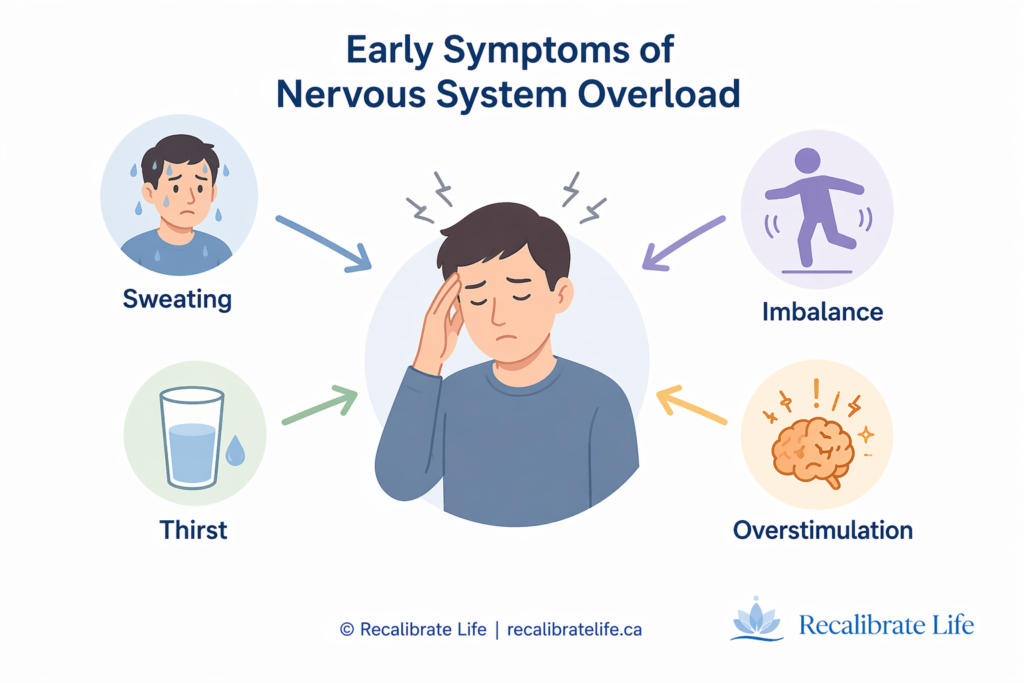
Some details from that first week are burned into my memory — not because they were dramatic, but because they were so unfamiliar.
The sweating. This was intense and completely new. My hands were constantly moist. My feet were soaking wet inside my shoes — socks completely drenched by the end of the day. My palms felt clammy all the time. It was like my entire system was in overdrive — overstimulated, overactive, running on high alert without knowing why. I’d never experienced anything like it.
The thirst. I started carrying a water bottle everywhere — even for short distances. I was constantly thirsty, in a way that felt deeper than just needing a drink. It was like my body was demanding something it couldn’t quite articulate. Even now, hydration is something I pay close attention to, and I still carry water with me everywhere I go.
The leg rush sensation. That strange energy surge through my legs at 7 PM — I kept thinking about it in the days after. What was that? Was it connected? At the time, I didn’t have enough context to understand it. Now, I believe it was my nervous system’s first noticeable signal that something had shifted — a brief, visible tremor in a system that was about to become much louder.
Driving with imbalance. Sitting behind the wheel and feeling that subtle unsteadiness — knowing you’re functional enough to drive safely, but also knowing that something isn’t right. It’s an unsettling feeling that’s hard to describe to someone who hasn’t experienced it.
When fear arrived
Fear didn’t hit me on the first night. It didn’t hit me the next morning, or even that first week. It built slowly.
Each day that the imbalance persisted, a small question grew a little louder: “What if this doesn’t go away?”
I’d been told one to two weeks. Then the weeks started passing. And the improvement everyone described wasn’t happening — or at least not in the way I expected. The spinning from BPPV improved with the Epley. But the underlying imbalance, the fog, the sensitivity to busy environments — those stayed.
That slow realization — that this might not be temporary — was scarier than any single symptom. Because it wasn’t a fear of one bad moment. It was a fear of a new reality. A fear that this is just how life feels now.
I want to be honest about that, because I think many people reading this are in that exact phase — waiting for it to go away, watching the days pass, wondering when “normal” comes back.
What I wish I’d known that night
If I could go back to 12:50 AM on July 24, feeling off-balance for the first time in a bright, noisy environment, here’s what I’d tell myself.
This isn’t random. There’s a pattern behind what you’re feeling, even though you can’t see it yet. The fact that you felt better in a quieter space — that’s your nervous system telling you something important about light, sound, and sensory load. Pay attention to that.
Start stabilizing your system now. Sleep. Food. Stress management. These aren’t secondary concerns — they’re the foundation your recovery will be built on. Every day you push through without addressing them is a day your system falls further behind.
BPPV might not be the whole story. The crystals are real and the Epley helps. But if the imbalance persists after the spinning stops, there’s something else going on. Don’t wait weeks to investigate that.
You’re not going to figure this out in a day. Understanding comes in layers. Each week you’ll learn something new about your body, your triggers, and your patterns. Be patient with the process even when it feels agonizingly slow.
This is going to be hard — but you’ll find your way through it. Not by powering through. Not by ignoring it. But by paying attention, tracking your patterns, and building a system around what you learn. That’s how recovery works with vestibular conditions — not a sudden cure, but a gradual recalibration.
That night at 12:50 AM, I didn’t know any of this. I thought I’d eaten something bad and needed a good night’s sleep.
I was wrong about the cause. But I wasn’t wrong about one thing: something had changed. And understanding that change — really understanding it — became the foundation of everything I’ve built since.
That’s why I started Recalibrate Life.
If you’re at the beginning of this journey and trying to make sense of what’s happening, my free Vestibular Trigger Checklist can help you start identifying patterns early. It covers food, light, sound, sleep, stress, and environmental triggers with a daily tracker built in. Drop your email and I’ll send it to you.
Related posts: