Before my symptoms started, I wore my lack of sleep like a badge of honour.
Four hours? Fine. Six hours? Luxury. I’d push through tiredness like it didn’t matter — because for years, it didn’t seem to. My mind was sharp on minimal sleep. I functioned. I performed. I never questioned it.
Then in early 2025, my routine shifted and I started sleeping around 3:30 AM regularly.I’d get five or six hours if I was lucky. On weekends, my timing shifted completely — different bedtime, different wake time, no consistency whatsoever. I didn’t think twice about it.
Four months later, on July 24, my vestibular symptoms started.
I’m not saying sleep alone caused my condition. But looking back, I was running my nervous system on empty for years — and when vestibular migraine arrived, there was nothing left in the tank to absorb the hit.
Sleep wasn’t just another trigger. It was the foundation that affected every other trigger. And ignoring that was the biggest mistake I made.
In this post:
- What I was doing wrong before symptoms started
- How sleep affects vestibular migraine specifically
- The dramatic before and after
- My current sleep system
- Why one bad night is manageable but two is not
Short version for brain fog readers: Inconsistent, insufficient sleep was my biggest mistake. After VM started, even one bad night noticeably worsened my dizziness, brain fog, and trigger tolerance. Fixing my sleep schedule — consistent timing, 7-8 hours — had a bigger impact on my symptoms than almost anything else I changed.
What I was doing wrong
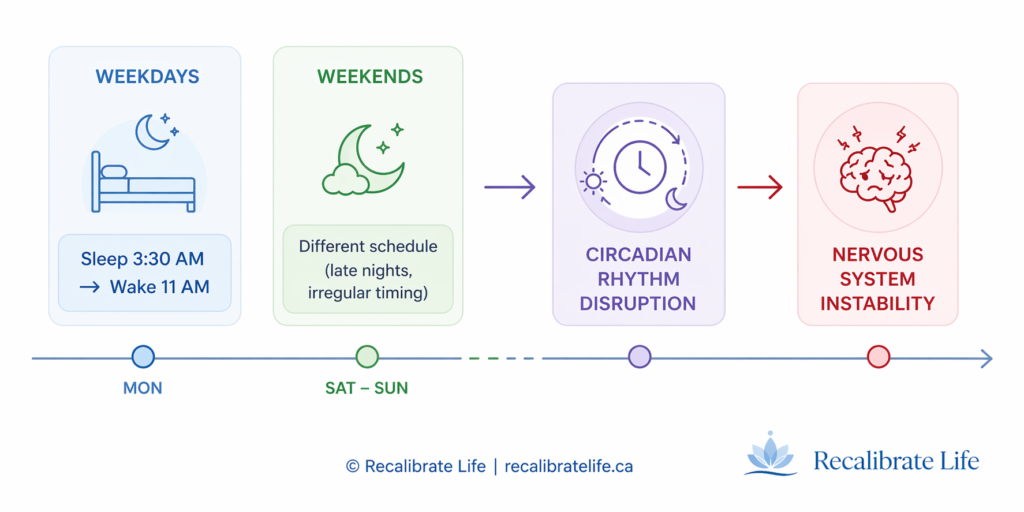
It wasn’t just that I slept too little. It was that my sleep had no consistency.
Before my symptoms started, my sleep pattern was chaotic. Some nights four hours, some nights six. Rarely the same bedtime two nights in a row. Weekdays looked completely different from weekends. I was running on caffeine and willpower, and it worked — until it didn’t.
As this pattern continued, the inconsistency got worse. Sleeping at 3:30 AM some nights, then shifting to a completely different schedule on other days. My body never knew when sleep was coming, how long it would last, or what rhythm to settle into.
Your circadian rhythm — the internal clock that regulates sleep, hormones, and brain function — depends on consistency. It’s not just about quantity. It’s about predictability. When you sleep at different times every night, your brain never fully optimizes any of the restorative processes that happen during sleep. You’re getting hours of sleep without getting the quality your nervous system needs to recover.
I didn’t know any of this at the time. I thought sleep was just about not being tired. I had no idea it was the foundation my entire neurological stability was built on.
How sleep affects vestibular migraine
Here’s what I learned after my symptoms started: sleep doesn’t just affect how tired you feel. It sets your threshold for every other trigger that day.
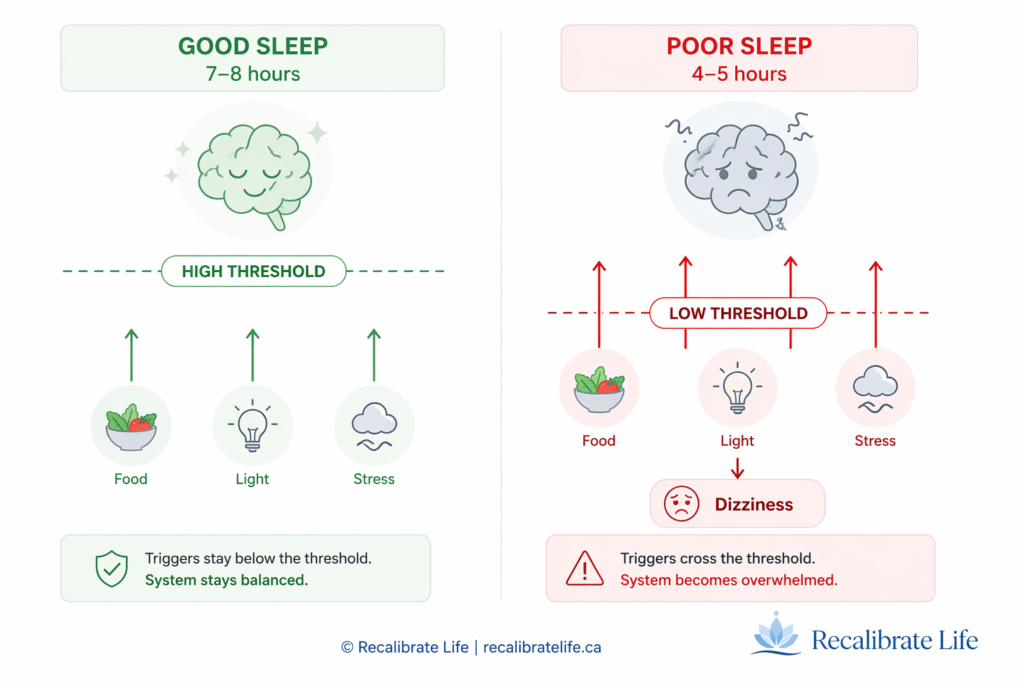
After a good night of consistent, sufficient sleep, my threshold is higher. I can handle more — a trigger food, a bright environment, a busier day. The same inputs that would normally push me over the edge stay manageable because my system has the capacity to process them.
After a poor night of sleep — or an inconsistent schedule — that threshold drops significantly. The exact same triggers hit harder. Food reactions are stronger. Light feels more overwhelming. Brain fog is thicker. Stress tolerance is lower. Everything amplifies because my system started the day with less capacity.
Food, light, stress — everything hit harder on days I didn’t sleep well. That pattern was one of the most consistent things I tracked. When I looked at my worst days and traced them back, poor sleep was almost always part of the picture — either that night or the one before.
This is why sleep isn’t just “another trigger” alongside food and light. It’s the trigger that controls how strongly all the other triggers affect you. Fix sleep, and everything else becomes more manageable. Ignore sleep, and nothing else you do will fully compensate.
The before and after
The contrast between how sleep affects me now versus before my symptoms is dramatic.
Before vestibular migraine, I could get away with four or five hours of sleep and still function at a high level. My brain compensated. My body pushed through. There were no obvious consequences — or at least none I noticed. Sleep felt optional, like something I could trade for more productive hours without a real cost.
After vestibular migraine, even one bad night changes my entire next day. If I don’t sleep around 11 PM and don’t get seven to eight hours, I wake up noticeably different. Grumpier. More irritable. My balance is off. The brain fog is heavier. My tolerance for everything — food, light, noise, activity — drops significantly.
It’s like my nervous system lost the ability to compensate. Before, it could absorb the hit of poor sleep without showing symptoms. Now, every shortfall shows up immediately — in my balance, my mood, my cognitive clarity, and my overall capacity to handle the day.
That was a hard adjustment. Going from someone who functioned on minimal sleep to someone who genuinely needs eight hours of consistent sleep isn’t just a schedule change — it’s an identity shift. But the data was undeniable. When I slept well, my days were better. When I didn’t, they weren’t. There was no arguing with it.
My current sleep system
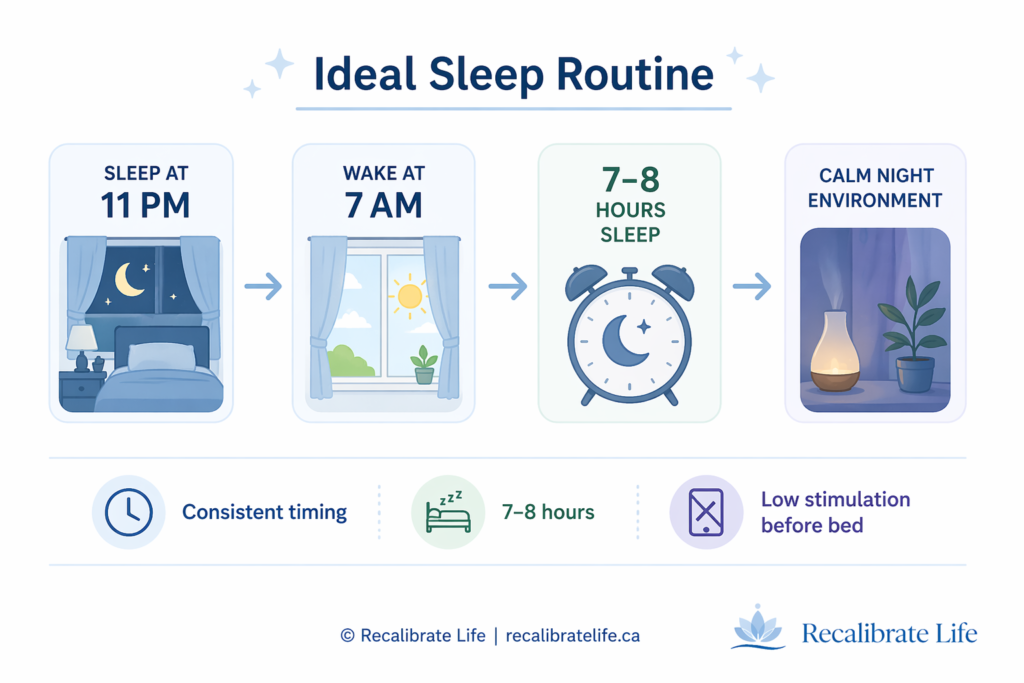
I don’t have a complicated sleep protocol. I have a pattern that I protect.
Consistent bedtime. I aim to be in bed by 11 PM every night. Not sometimes. Not most nights. Every night. That consistency is what my circadian rhythm depends on. The predictability matters as much as the duration.
Seven to eight hours minimum. This is non-negotiable now. I used to treat sleep as the variable I could cut when I needed more time. Now it’s the one thing I don’t compromise on, because everything else depends on it.
Weekends stay mostly consistent. This was one of the hardest habits to build. The temptation to stay up late on weekends is real — watching a movie, scrolling, enjoying the freedom of no schedule. I occasionally do stay up until 1 AM on a weekend night — maybe once every week or two. But I’ve learned that occasional is the key word. One late night is manageable. Back-to-back disruption is not.
Wind-down routine. Reducing screen brightness in the evening. Dimming the lights. Letting my brain transition into rest mode gradually rather than going from full stimulation to sleep in five minutes. This isn’t rigid — some nights I do it better than others. But the intention is consistent.
No heavy meals close to bedtime. I noticed that eating trigger foods late in the evening made sleep worse and the next morning foggier. Keeping dinner simpler and earlier improved both sleep quality and how I felt when I woke up.
Why one bad night is manageable but two is not
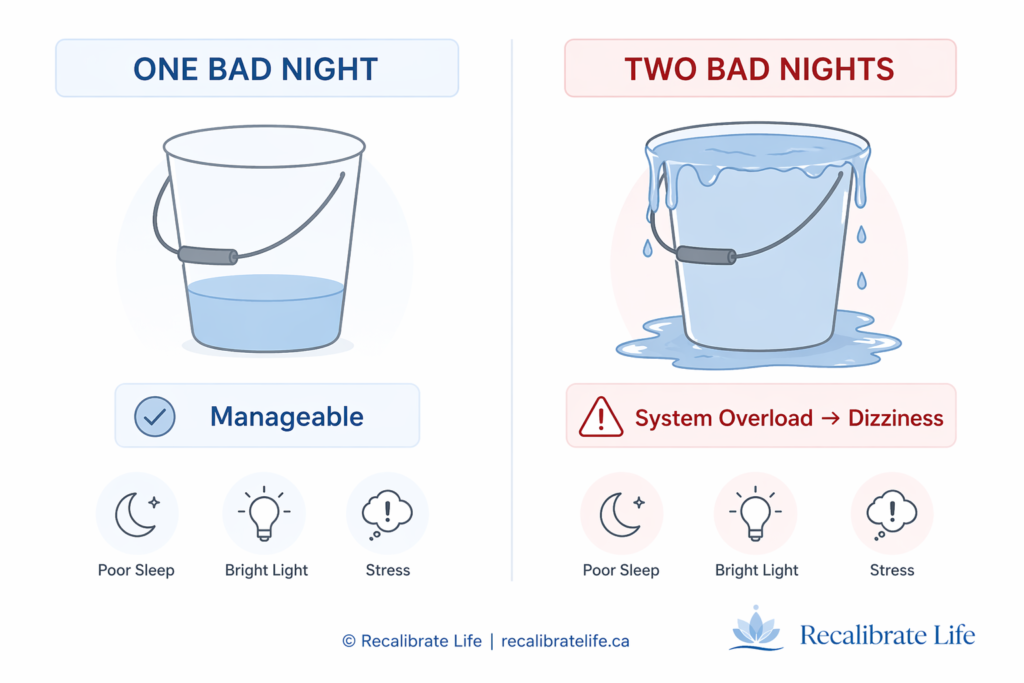
This is one of the most important patterns I discovered.
A single night of poor sleep — staying up late, sleeping inconsistently, getting fewer hours — usually doesn’t crash me completely. The next day is harder, but manageable. My system can absorb one hit.
But back-to-back poor sleep — two nights in a row of disrupted or insufficient sleep — reliably leads to a crash. The dizziness gets heavier. Brain fog thickens significantly. Balance is noticeably worse. My trigger tolerance drops to the point where even mild inputs can push me over.
It’s the stacking effect again, applied to sleep. One bad night adds load to the bucket. If the second night is good, the bucket empties and I recover. If the second night is also bad, the bucket overflows — and the crash can take days to fully recover from.
This is why I protect my sleep schedule so carefully now. Missing one night isn’t the end of the world. But I never let it become two. That’s the line I don’t cross.
Sleep is the foundation, not a luxury
If there’s one thing I could go back and tell myself before any of this started, it would be this: sleep consistency isn’t optional. It’s the single most important thing your nervous system needs to function properly.
I spent years treating sleep as something I could sacrifice without consequences. And maybe for a while, my body compensated. But it was accumulating a debt that eventually came due — in the form of a nervous system that was too depleted to handle what vestibular migraine threw at it.
Now, sleep is the first thing I manage, not the last. Before I think about food, light, exercise, or any other trigger — I make sure the foundation is solid. Because when sleep is right, everything else gets easier. And when sleep is wrong, nothing else fully compensates.
It wasn’t just that I slept less. It was that my sleep had no consistency. Fixing that had a bigger impact on my recovery than almost anything else I changed.
If you’re early in your vestibular journey and wondering where to start — start with sleep. It won’t fix everything. But it’ll give your system the foundation it needs for everything else to work better.
If you’re tracking your triggers and want to see how sleep fits into your overall pattern, my free Vestibular Trigger Checklist includes a daily tracker that logs sleep alongside food, light, sound, stress, and symptoms. Drop your email and I’ll send it to you.
Related posts: