Here’s something nobody prepared me for.
I can walk into a busy restaurant and not feel dizzy. Not spinning, not rocking, not obviously off-balance. By any visible measure, I’m fine. I sit down, order food, have a conversation.
Then I get home and I’m completely empty. Mentally wiped out. Foggy. Drained in a way that doesn’t match what I actually did. All I did was eat dinner. But my body is responding like I ran a marathon.
This is one of the most confusing parts of living with a vestibular condition — the drain that happens without obvious dizziness. The exhaustion that shows up after an environment that shouldn’t have been exhausting. The energy that disappears without a clear explanation.
If you’ve experienced this — feeling destroyed after being somewhere busy, even though you didn’t feel “dizzy” while you were there — you’re not imagining it. Your nervous system was working overtime the entire time. You just didn’t feel it until the bill came due.
In this post:
- Why busy environments drain you without making you dizzy
- The environments that hit hardest
- The delayed crash most people don’t expect
- How I manage my energy now
- Why energy became a budget I don’t overspend
Short version for brain fog readers: Busy environments drain you because your brain is constantly processing sensory input — light, sound, movement, spatial orientation — even when you don’t feel actively dizzy. That processing uses enormous energy. The drain often shows up after you leave, not while you’re there. Managing it means treating energy as a limited resource and being intentional about where you spend it.
Why it drains you without dizziness
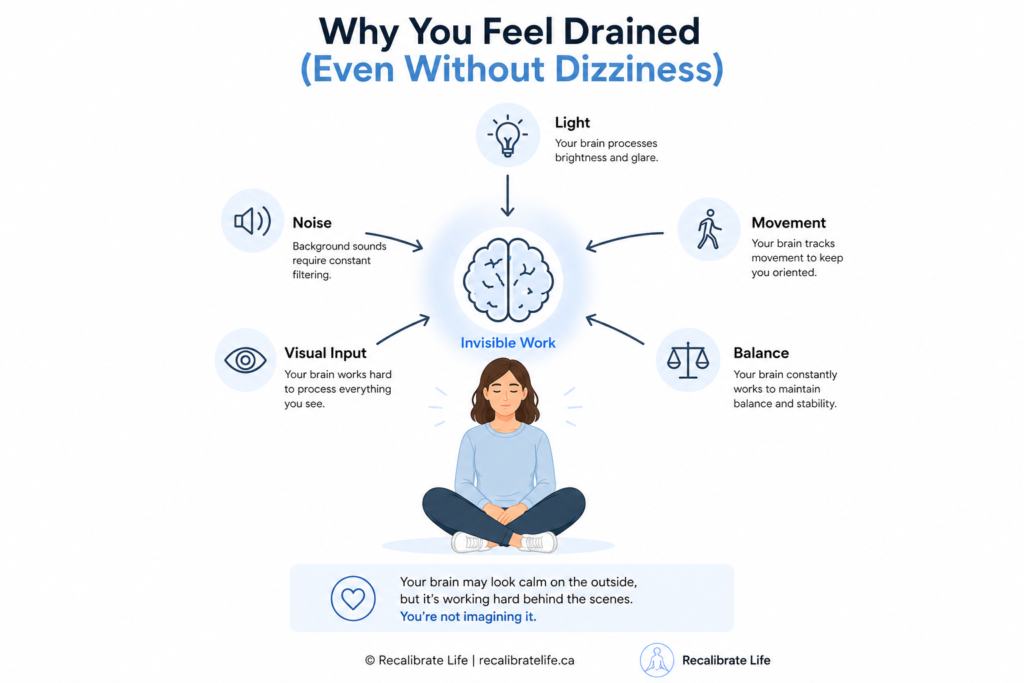
This was the part that confused me the most. If I wasn’t dizzy, why was I so exhausted?
The answer is that your brain is doing invisible work the entire time you’re in a stimulating environment — and that work costs energy whether you feel dizzy or not.
In a busy space, your vestibular system is constantly processing: bright overhead lighting, background noise from multiple sources, people moving unpredictably in your peripheral vision, visual clutter from signage and displays, spatial changes as you move through the space, and the ongoing task of keeping you balanced through all of it.
In a healthy system, this processing happens efficiently and automatically. The energy cost is minimal. You walk through a busy restaurant or a crowded mall and don’t think twice about it.
With vestibular migraine, that processing is no longer efficient. Your brain works harder to achieve the same result — filtering noise, stabilizing balance, managing visual input, monitoring anxiety. Every one of these tasks draws from the same limited energy pool. And even if the system manages to keep you balanced — even if you never feel overtly dizzy — the energy expenditure is massive.
It’s not dizziness. It’s sensory overload. Your system handled it, but it used everything it had to do so.
My system isn’t broken — it’s just more sensitive to input right now. And sensitivity means higher energy cost for the same experiences that used to be effortless.
The environments that hit hardest
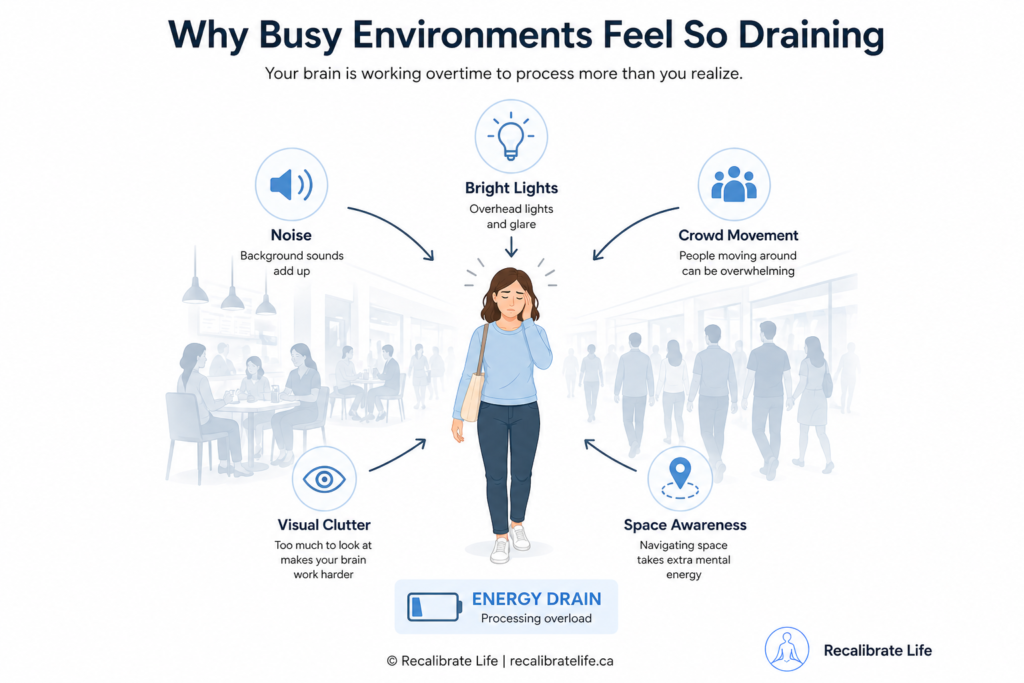
Not all busy environments are equally draining. Through experience, I’ve learned which ones cost the most energy.
Restaurants are surprisingly draining. Loud conversations layering over each other, background music, bright or uneven lighting, visual complexity of a busy dining room, the sensory input of food itself — it’s a lot for a sensitized system to process simultaneously. I’ve started wearing earplugs in louder restaurants. Not enough to block conversation — just enough to reduce the overall noise level by a few decibels. That small reduction makes a meaningful difference in how drained I feel afterward.
Malls and large retail spaces are manageable for short periods but drain quickly if I stay too long or visit during peak hours. The combination of fluorescent lighting, visual motion from crowds, wide open spaces requiring constant spatial processing, and background noise from every direction creates a sustained processing load that accumulates over time.
Environments with continuous noise are surprisingly impactful. Not loud sudden sounds — continuous ones. I noticed this on my morning walks. If someone is mowing their lawn nearby, that constant drone of the mower drains me faster than a car horn or a dog barking. Sustained noise forces your brain to continuously filter it, which is more depleting than brief bursts of loud sound.
Large open spaces with lots of movement — airports, busy intersections, open-concept buildings — require your brain to constantly track spatial information across a wide visual field. Everything is moving, nothing is predictable, and your vestibular system has to process all of it to keep you oriented.
Social gatherings are one I haven’t tested since my symptoms started. I haven’t attended a family gathering since July 2025 — not out of fear, but out of energy management. Multiple conversations happening simultaneously, background noise, unfamiliar or semi-familiar environments, the social energy required to engage — it’s a significant processing load. This is something I plan to gradually reintroduce as my tolerance improves.

Track symptoms, triggers, medications, appointments and recovery progress.
View on Etsy →
The delayed crash
This is the part most people don’t expect — and it’s what makes this type of drain so confusing.
You can feel okay during the experience. You manage the restaurant, handle the mall, get through the outing. You come home and think “that went well.”
Then two hours later — or the next morning — the drain hits. Brain fog rolls in. Energy drops. Maybe imbalance shows up. You feel significantly worse than you did during the actual outing.
This is the delayed crash. Your nervous system handled the load in real time — it kept you functional, kept you balanced, kept you processing. But it used reserves it didn’t actually have. And the bill arrives later.
The duration of the crash depends on how many triggers you stacked. If the environment was the only trigger — and your sleep was good, food was clean, stress was low — you can return to baseline fairly quickly once you’re back in a controlled space. I’ve found that moving myself away from draining environments as soon as I notice discomfort helps me recover faster.
But if you stacked triggers — busy environment plus poor sleep plus a trigger meal plus a stressful day — the crash can last days. The more load in the bucket before the environment, the longer the recovery after.
This is why some outings barely affect you and others knock you down for days. It’s not random. It’s the total system load determining the cost of the experience.
How I manage my energy now
Energy management with vestibular migraine isn’t something I ever thought I’d need to learn. But it’s become one of the most practical skills in my daily life.
Pre-loading before draining environments. Before I go somewhere I know will be demanding — a restaurant, a store, an appointment — I make sure the controllable triggers are managed. Good sleep the night before. Clean, simple food. Low stress. If I’m going into a demanding environment, I want my bucket as empty as possible before I arrive. This is trigger buffering — creating headroom in your system so the environment doesn’t push you over.
Carrying my kit. My toolkit goes everywhere: water bottle, SOS medication, and earplugs. The medication I rarely use — but having it reduces the anticipatory anxiety. The water keeps me hydrated, which genuinely affects how my system handles load. The earplugs are the most used tool — reducing noise by even a few decibels in a loud restaurant or busy space makes a measurable difference in how drained I feel afterward.
Shorter, more intentional exposure. I don’t linger in draining environments anymore. I go with a purpose, accomplish what I need, and leave. No unnecessary browsing, no extending the visit because “I feel okay right now.” I’ve learned that feeling okay in the moment doesn’t mean my system isn’t accumulating load. Leaving while I still feel fine means I recover faster than if I stayed until symptoms appeared.
Leaving before I need to. This was a hard habit to build. The instinct is to stay until things get bad and then leave. But by that point, the overload has already happened and the crash is coming. Leaving early — while I still feel manageable — means the total load stays below my threshold. It feels like I’m leaving too soon. But the next day’s energy level proves it was the right call.
Resting after without guilt. Coming home from a draining environment and resting isn’t laziness — it’s recovery. My brain just processed an enormous amount of input. It needs time to settle. I give it that time without feeling guilty about it, because I know that rest after exposure is what allows me to expose again tomorrow.
Energy is a budget I don’t overspend
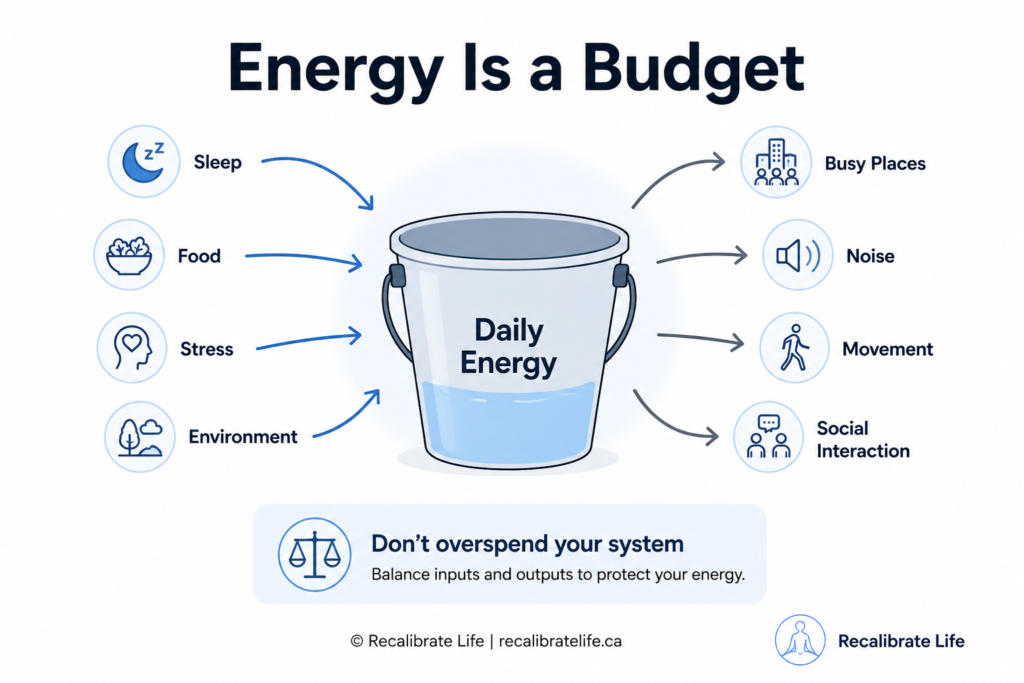
The biggest mindset shift was learning to treat energy like a limited resource — a daily budget that I allocate intentionally rather than spend randomly.
Before vestibular migraine, energy felt infinite. I could go anywhere, do anything, stay as long as I wanted, and recover by morning. That’s not how it works anymore.
Now, I know that a busy restaurant costs a certain amount of energy. A grocery store trip costs a certain amount. A social interaction in a noisy space costs a certain amount. And I only have so much to spend each day.
I don’t spend energy randomly anymore. I allocate it. If I know I have a demanding outing in the afternoon, I keep the morning low-stimulation. If I had a draining day yesterday, I budget less exposure today. If my sleep was poor, I reduce the total load planned for the day.
This isn’t living in fear. It’s living strategically. The goal isn’t to avoid everything forever — it’s to gradually build tolerance while managing the budget wisely. Every successful outing where I come home without crashing is evidence that my system is adapting. And over time, the budget gets a little larger.
Even when I look normal, I’m working harder
From the outside, nothing looks unusual. I’m sitting in a restaurant eating dinner. I’m walking through a store. I’m having a conversation. Normal activities that normal people do without thinking.
But internally, my brain is running at a higher processing level than the person next to me. Filtering noise, stabilizing balance, managing visual input, monitoring my state, calculating how much longer I can sustain this before the cost exceeds my budget.
That invisible effort is the core of why busy environments drain me. Not because I’m weaker than I used to be — but because my system currently costs more to run. The same inputs that used to be processed for free now carry a price. And when you’re paying for something that used to be free, the budget runs out faster.
Understanding that doesn’t eliminate the drain. But it explains it. And explanation turns confusion into something manageable — which is the entire point of recalibrating.
It’s not that I can’t handle busy environments anymore. It’s that my system needs more control over how I experience them.
If you’re trying to understand how different environments and triggers affect your energy and symptoms, my free Vestibular Trigger Checklist includes a daily tracker that helps you see these patterns over time. Drop your email and I’ll send it to you.
Related posts: