Before vestibular migraine, I never thought about multitasking. It was automatic — cooking while watching something, scanning shelves while walking through a store, having a conversation while navigating a busy space. My brain handled it all in the background without me even noticing.
Now, multitasking outside my home is one of the fastest ways to overwhelm my system. Not because I’ve lost the ability — but because my brain is already using so much energy just to keep me balanced that adding anything on top pushes it past its limit.
The problem wasn’t doing two things. It was doing two things while my brain was already overloaded.
In this post:
- Why multitasking feels different now
- Home vs outside — why one is manageable and the other isn’t
- The store aisle problem
- How I adapted
- Why slowing down isn’t a limitation
Short version for brain fog readers: Multitasking is harder with vestibular migraine because your brain is already working overtime to maintain balance. At home in a controlled environment, it’s usually manageable. Outside — in stores, busy spaces, unfamiliar environments — your brain is already processing so much sensory input that adding any extra task can tip the system. Slowing down and doing one thing at a time isn’t a weakness. It’s a strategy.
Why multitasking feels different now
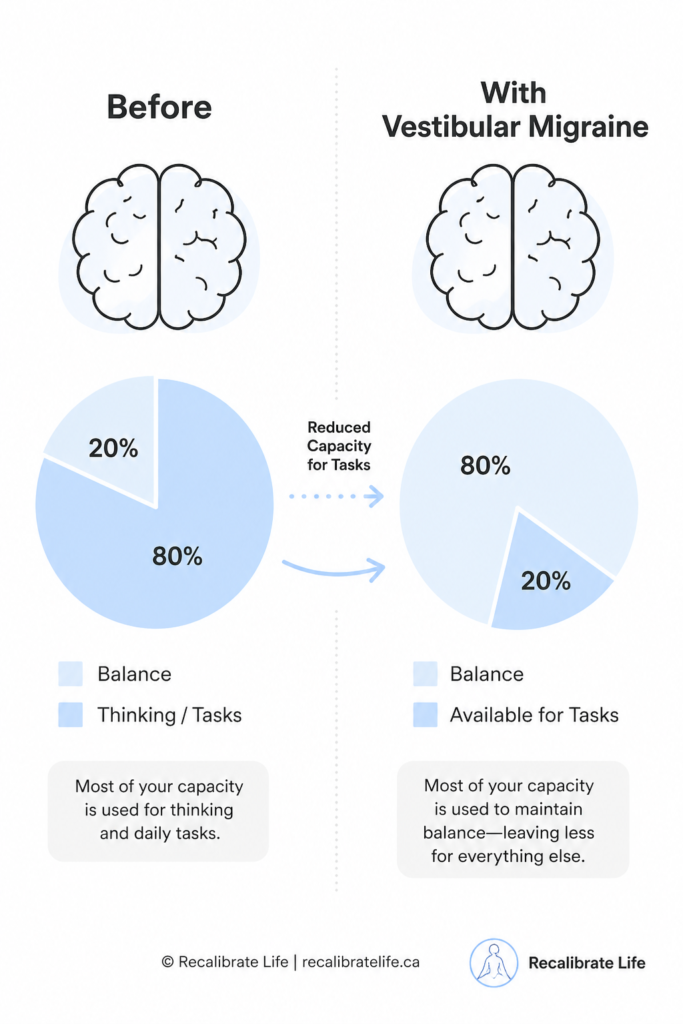
In a healthy vestibular system, balance runs in the background. It’s automatic — like breathing. Your brain processes spatial orientation, visual input, and body position without you thinking about it, which leaves plenty of capacity for everything else: conversations, decision-making, scanning your environment, planning your next move.
With vestibular migraine, that automatic process breaks. Your brain has to consciously manage balance — and that takes up a significant portion of your processing capacity. What used to run silently in the background now demands active attention.
So when you try to do something on top of maintaining balance — like scanning store shelves while walking, or following a conversation while navigating a busy environment — your brain has to split its limited resources between balance and the task. And when the total demand exceeds your available capacity, the system overloads. Dizziness spikes. Brain fog thickens. Anxiety kicks in.
It’s not that you can’t multitask anymore. It’s that the cost of multitasking is much higher because balance is no longer free. Every additional task competes with the processing power your brain needs just to keep you upright and oriented.
Home vs outside — two completely different experiences
One of the clearest patterns I noticed is how dramatically different multitasking feels at home compared to outside.
At home, multitasking is usually manageable. I can watch something on TV while cooking. I can run the dishwasher while tidying up the kitchen. I can move between tasks without much difficulty. My stamina has definitely decreased compared to before — I can’t sustain it as long as I used to. But the multitasking itself works because the environment is controlled. The lighting is familiar. The sounds are predictable. My brain knows this space, so it spends less energy on orientation and has more capacity available for tasks.
Outside is a completely different story. The moment I step into an uncontrolled environment — a store, a mall, a busy street — my brain shifts into a different mode. It’s no longer casually processing the surroundings. It’s actively scanning: lights overhead, people moving in my peripheral vision, sounds layering from multiple directions, visual complexity from products and signage, the ground surface changing, my body trying to stay balanced through it all.
That scanning is the first task. Before I even try to find something on a shelf or follow a conversation or make a decision, my brain is already working hard just to orient me in the space. So when I add anything on top of that — looking up and down an aisle, comparing products, navigating around other shoppers — the total processing load spikes.
At home, multitasking is manageable because the environment is controlled. Outside, multitasking becomes harder because my brain is already using energy just to stay oriented. The environment itself became the first task.
The store aisle problem
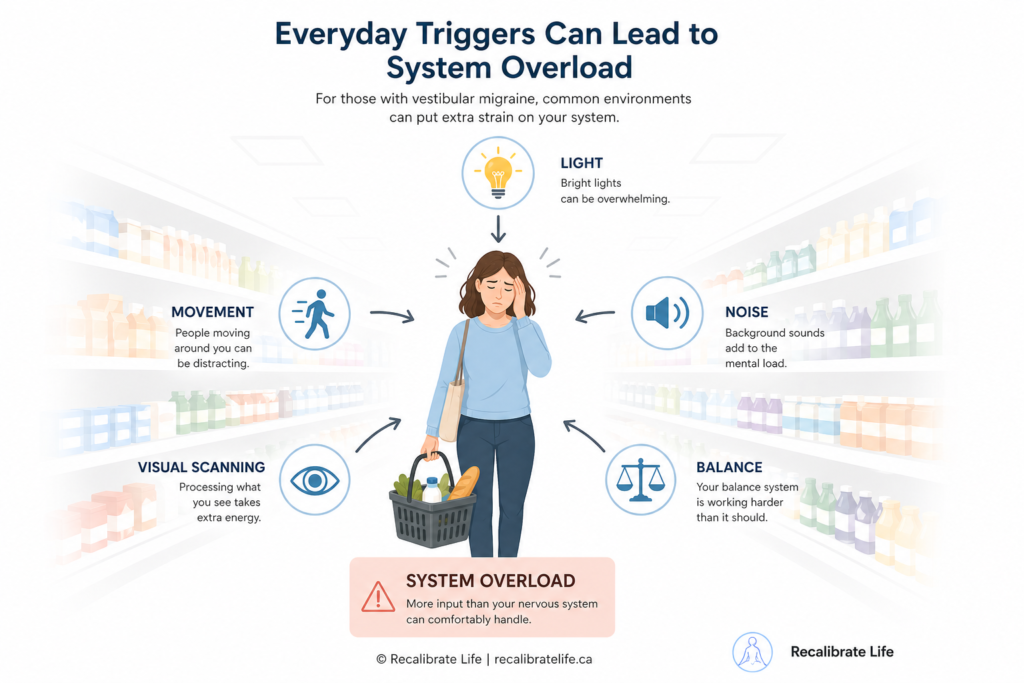
This is where the multitasking overload shows up most clearly for me.
Walking through a store aisle sounds simple. But for a sensitized vestibular system, it’s actually a complex multitasking operation. You’re walking — which requires balance processing. You’re scanning shelves — which means your eyes are moving up, down, left, and right while your body moves forward. You’re processing bright overhead lighting. You’re tracking people moving around you in your peripheral vision. You’re trying to find specific items — which adds cognitive load on top of the sensory load. And you’re trying to stay balanced through all of it.
Each one of those things alone would be manageable. Stacked together, they create a processing demand that a sensitized brain struggles to keep up with.
I’ve learned that the up-and-down scanning is one of the worst parts. Looking up at a high shelf and then down at a low shelf while walking forward creates rapid visual changes that my vestibular system has to constantly recalibrate for. Before VM, my brain handled this without me noticing. Now, each visual shift is a processing event that adds to the total load.
This is why grocery stores, big-box retailers, and any environment with tall aisles and dense visual information feel so much harder than they should. It’s not just the lights and noise — it’s the multitasking demand of navigating, scanning, selecting, and balancing all at the same time.
How I adapted
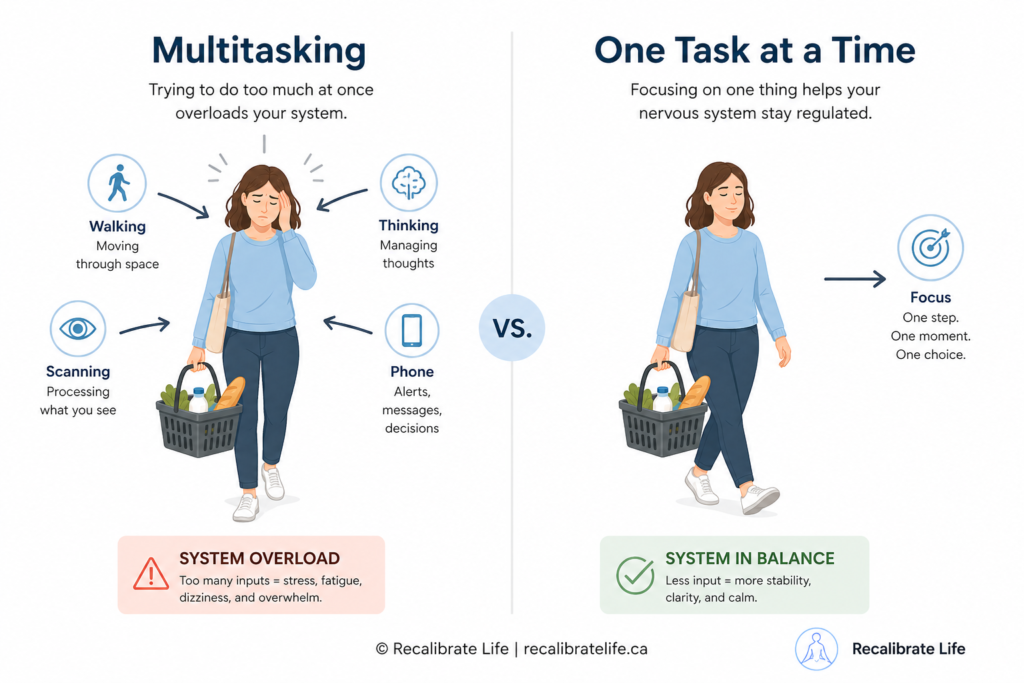
I didn’t stop going to stores or navigating the outside world. I changed how I move through it.
One direction, one focus. I don’t browse anymore — at least not the way I used to. Instead of wandering up and down aisles scanning everything, I walk with a specific focus. I know what I’m looking for. I go to that section. I find it. I move on. That eliminates the random scanning that overloads my visual system.
Walking slower. This sounds obvious, but it makes a real difference. Walking fast in a busy environment means your brain has to process visual changes faster — people passing, shelves scrolling by, lighting shifting. Slowing down gives my brain more time to process each visual frame without falling behind. I’m not rushing through the store anymore. I’m pacing through it.
Reducing unnecessary visual scanning. I’ve trained myself to keep my gaze more focused — looking at what’s directly in front of me rather than scanning the full length of an aisle or tracking movement in my peripheral vision. Less visual input means less processing demand means more capacity for actually finding what I need.
Having a list and a plan. Going into a store with a clear list eliminates the cognitive load of deciding what I need while also navigating the space. The decisions are already made. I just need to execute. That frees up mental bandwidth that would otherwise compete with balance processing.
Not combining tasks outside. I don’t talk on the phone while walking through a store. I don’t try to compare prices on my phone while standing in an aisle. I don’t add any task that isn’t essential. Each additional input — even a phone screen — takes from the same limited pool of processing capacity that my balance depends on.

Track symptoms, triggers, medications, appointments, and recovery progress.
View on Etsy →
Why slowing down isn’t a limitation
There was a period where this felt like loss. I used to move quickly, multitask effortlessly, handle complex environments without a second thought. Now I was walking slowly through a grocery store, looking straight ahead, doing one thing at a time. It felt like I’d been downgraded.
But the reframe that changed everything was this: doing one thing at a time outside isn’t a limitation. It’s a strategy.
I’m not slower because I’m less capable. I’m slower because I’m managing my resources intentionally. I’m choosing where to allocate my brain’s processing power rather than letting it get pulled in every direction at once. That’s not weakness — that’s awareness.
And practically, it works better. I get through store trips more successfully. I crash less often afterward. My recovery time is shorter. The anxiety before entering stores has decreased because I know I have a system for handling them.
The irony is that by doing less in the moment, I accomplish more overall — because I’m not paying for every outing with a next-day crash.
The invisible multitasking nobody sees
From the outside, I might look like someone who’s just walking slowly through a store. Nothing noteworthy. Nothing that would make anyone think “that person is managing something difficult.”
But internally, the processing load is significant. I’m managing balance, visual input, light sensitivity, sound processing, spatial orientation, anxiety, and the cognitive task of finding what I need — all simultaneously. That’s not one task. That’s seven.
Most people around me don’t see that. And honestly, there’s no reason they would — vestibular conditions are invisible by nature. But if you’re reading this and you know exactly what I’m describing — the mental exhaustion of walking through a store, the relief of getting back to your car, the feeling that something as simple as grocery shopping shouldn’t be this hard — you’re not alone. And you’re not being dramatic. Your brain is genuinely working harder than the person next to you, because balance is no longer free.
Understanding that doesn’t fix it. But it explains it. And explanation is the first step toward building a system that works.
If you’re trying to understand how different triggers — light, sound, food, activity — stack together and affect your symptoms, my free Vestibular Trigger Checklist includes a daily tracker that helps you see these patterns over time. Drop your email and I’ll send it to you.
[Email signup form]
Related posts: