Before vestibular migraine, leaving the house required three things: phone, wallet, keys. I never thought about it. I just walked out the door.
Now, every time I step outside, there’s a small system that comes with me. Not because I’m fragile — but because I’ve learned that the difference between a manageable outing and a crash often comes down to a few small items and a little bit of preparation.
None of it is complicated. None of it is expensive. But together, these simple tools create something bigger than the sum of their parts: a sense of control in environments I can’t fully control.
In this post:
- Every item in my daily toolkit and why it matters
- How I keep everything accessible without overthinking
- How the toolkit changed from fear-based to strategic
- What I tried that turned out to be unnecessary
- The real shift that mattered more than any item
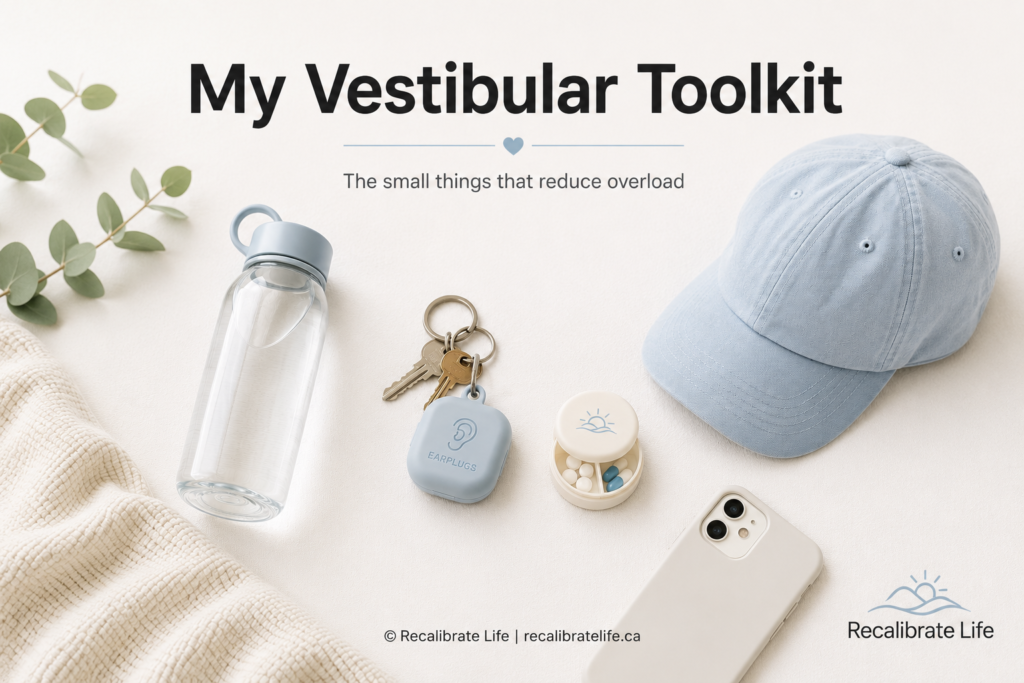
Short version for brain fog readers: I carry earplugs (on my keychain), SOS medication, a water bottle, and a cap. That’s it. Each one reduces a specific type of sensory load. The toolkit isn’t about preparing for disaster — it’s about reducing friction between me and the outside world so I can do more without crashing.
The items
Earplugs — on my keychain, always within reach
This became one of the most useful additions to my daily life, and the way I carry them makes the difference.
I clipped my earplug case to my house and car keys. That means they’re never forgotten, never left behind, always in my pocket or within arm’s reach. When I walk into a loud restaurant, a busy store, or any environment where continuous noise starts building — I don’t have to dig through a bag or wish I’d remembered to bring them. They’re right there on my keys.
I don’t use them to block sound completely. That’s not the point. I use them to reduce the intensity by a few decibels — just enough to lower the processing load on my brain. The difference between full-volume restaurant noise and slightly-reduced restaurant noise is the difference between lasting twenty minutes and lasting forty-five.
One thing I noticed is that continuous noise drains me more than sudden noise. A lawnmower droning during my morning walk, the constant chatter of a busy restaurant, the hum of a crowded mall — that sustained input forces my brain to continuously filter it, and that filtering costs energy. Earplugs reduce that cost. They’re the simplest tool I carry and probably the one I’d miss the most.
SOS medication — always in my pocket
I carry my rescue medication every single day. And honestly, I rarely use it.
That sounds contradictory, but the biggest benefit isn’t the medication itself — it’s knowing it’s there. When you live with a condition that can spike unpredictably, a significant part of the difficulty is the anticipatory anxiety. “What if things get bad?” “What if I can’t handle this environment?” “What if I need to leave?”
Having the medication in my pocket answers all of those questions with: “If things get bad, I have something I can take.” That one reassurance lowers the anxiety before I even walk through the door. And lower anxiety means my nervous system is less primed to overreact to sensory input — which means the environment is actually easier to handle.
Most days, the medication stays in my pocket untouched. But it changes how safe the environment feels. And feeling safe is not a small thing when your nervous system is sensitized.
Water bottle — small one on me, carton in the car
Hydration became non-negotiable almost immediately after my symptoms started. During those first weeks, I was constantly thirsty — a deep, persistent thirst that felt like my body was demanding something it couldn’t articulate.
Now, the thirst isn’t as intense, but the habit stuck — because hydration genuinely affects how my system performs. On days when I haven’t been drinking enough water, the imbalance is more noticeable, the brain fog is thicker, and my tolerance for triggers drops. Staying consistently hydrated is one of the simplest things I do that has a measurable impact on my symptoms.
I carry a small water bottle whenever I leave the house. And I keep a full carton of water bottles in my car at all times. That might sound excessive, but it means I’m never caught without water — not on a long outing, not after a draining appointment, not on a hot day when dehydration can sneak up fast. It removes one more variable from the equation.
Cap — my light filter
This one might sound unusual for a toolkit, but wearing a cap in overstimulating environments has become a quiet game-changer.
Overhead fluorescent lighting in stores, hospitals, malls, and offices is one of my most consistent triggers. A cap reduces the amount of light reaching my eyes from above — narrowing my visual field slightly and cutting down the harsh overhead glare that my brain has to process.
I don’t wear it everywhere. At home, I don’t need it. On walks in natural light, I usually don’t need it. But in any environment with strong artificial lighting — a grocery store, a medical office, a bright commercial space — the cap goes on. It’s a subtle adjustment that makes a noticeable difference in how long I can tolerate the environment and how drained I feel afterward.
Nobody notices. Nobody questions it. But it’s quietly doing important work.

Track symptoms, triggers, medications, appointments, and recovery progress.
View on Etsy →
Phone — used differently now
My phone is always with me, but my relationship with it changed after vestibular migraine.
Before, my phone was constant stimulation — scrolling while walking, checking notifications in every environment, using it while doing other things. Now, I use it more intentionally.
I avoid scrolling while walking — the combination of visual motion on a screen plus physical movement plus environmental processing is a fast track to overload. I don’t use my phone while navigating a store — adding screen processing on top of balance, visual scanning, and environmental management is asking too much from a system that’s already working hard.
My phone is still a tool. But it’s no longer constant background stimulation. It’s used when I’m stationary, when the environment is calm, and when it doesn’t compete with other processing demands.
How I keep it accessible without overthinking
The whole system works because it’s simple and automatic.
Earplugs are on my keys. If I have my keys, I have my earplugs. No separate case to remember. No extra pocket to check.
SOS medication stays in the same pocket every day. I don’t think about it. I just know it’s there.
Water bottle is part of leaving the house — the same way I grab my phone and wallet. The car carton is always restocked.
Cap goes on when I’m heading into a bright environment. It’s automatic now — I don’t decide each time. If I’m going into a store or appointment, the cap comes with me.
The goal is zero decision fatigue around the toolkit. It should feel like grabbing your phone before you leave — automatic, effortless, and you notice immediately when it’s missing.
How the toolkit changed over time
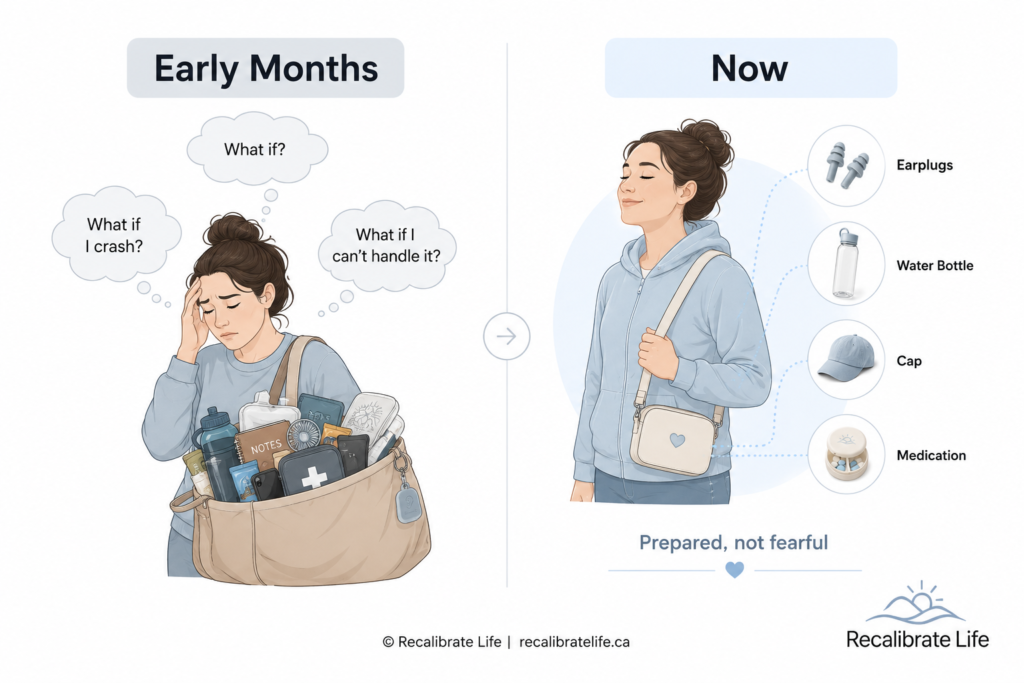
In the early months, my approach to leaving the house was fear-based.
I was over-preparing mentally for every outing. Running through worst-case scenarios. Checking and rechecking that I had everything. The toolkit felt like a survival kit — something I desperately needed because the outside world had become hostile.
Over time, something shifted. The fear reduced. The preparation became routine instead of anxious. And I started noticing which items actually made a difference versus which ones I was carrying out of fear.
I realized I didn’t need to carry everything for every possible scenario. I needed to carry the things that genuinely reduced my system’s load — and nothing more. The toolkit got simpler as my understanding got clearer.
That shift — from fear-based to strategic — was one of the most important transitions in my recovery. It meant I was no longer preparing for disaster. I was engineering a better experience.
What I tried that didn’t matter
This is worth sharing because many people early in their journey overcomplicate their toolkit.
Over-monitoring symptoms didn’t help. Constantly checking “how do I feel right now?” actually increased my anxiety and made symptoms feel worse. The mental energy spent monitoring was itself a drain.
Carrying too many “just in case” items added weight and mental friction without adding value. The more I carried, the more I felt like a patient instead of a person going about their day.
Constantly researching in the moment — checking my phone for reassurance about symptoms while in a triggering environment — added cognitive load when I needed less, not more.
The most effective tools turned out to be the simplest ones: hydration, noise reduction, light management, and the psychological safety of backup medication. Everything else was noise.
The shift that mattered more than any item
The real change wasn’t the toolkit. It was the mindset behind it.
Before vestibular migraine, my approach to the outside world was: push through whatever comes. Handle it. Tough it out.
After vestibular migraine, the approach became: reduce unnecessary load so your system can handle what matters.
That shift — from pushing through to reducing friction — changed how I experience every environment outside my home. I’m not fighting the world anymore. I’m working with my system’s current capacity and giving it the best possible conditions to function.
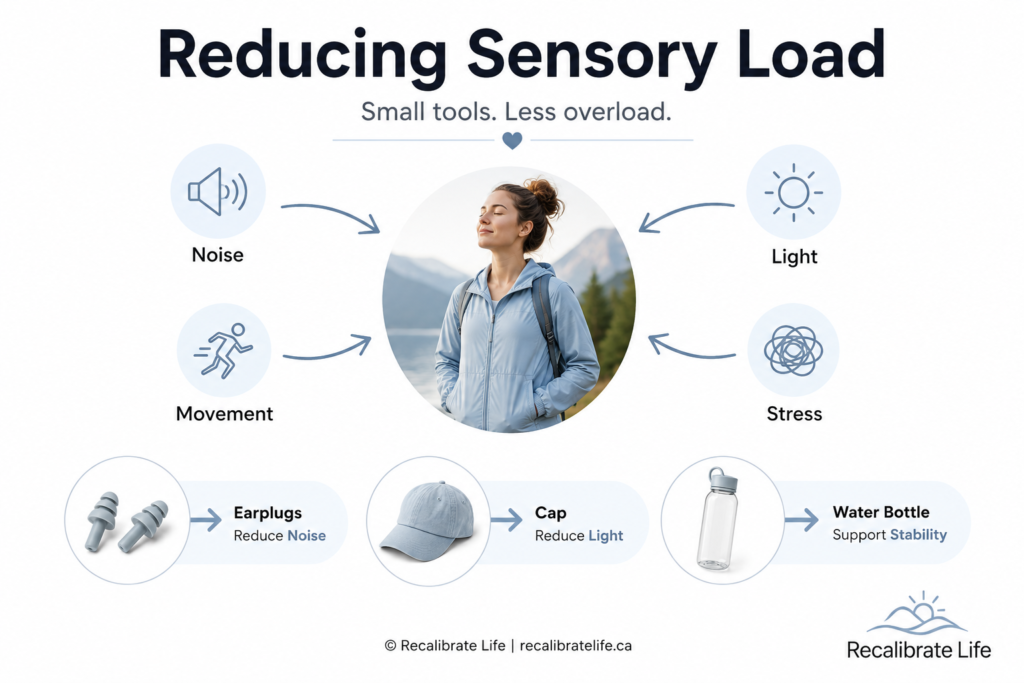
The toolkit is just the physical expression of that mindset. Earplugs reduce sound load. The cap reduces light load. Water maintains hydration. The medication reduces anxiety load. Together, they don’t eliminate vestibular migraine — they help me move through the world with less friction.
And less friction means more capacity for actually living.
If you’re trying to understand your own triggers and figure out what tools and strategies help you most, my free Vestibular Trigger Checklist includes a daily tracker to help you see patterns over time. Drop your email and I’ll send it to you.
Related posts: