A bad day hits and your first thought is: “I’ve lost everything.”
All the progress. All the good days you’d been building. All the careful management of triggers and sleep and food — wiped out in one morning of heavy dizziness and thick brain fog.
I’ve had that thought more times than I can count. And for a long time, every bad day felt like proof that I was back to square one. That recovery was an illusion. That nothing was actually getting better.
Until I learned to tell the difference between a flare and a setback. That distinction changed how I experience bad days entirely — not because the symptoms got easier, but because the fear around them got smaller.
In this post:
- What a flare actually is vs a real setback
- How to tell which one you’re in
- A simple framework to check (with visual)
- What to do during each one
- The emotional side nobody talks about
Short version for brain fog readers: A flare is your system getting temporarily overloaded — usually from stacked triggers. It settles with rest and reduced load. A setback is when your baseline itself shifts for a while. Most bad days are flares, not setbacks. Learning the difference stops you from panicking every time symptoms spike.
What a flare actually feels like
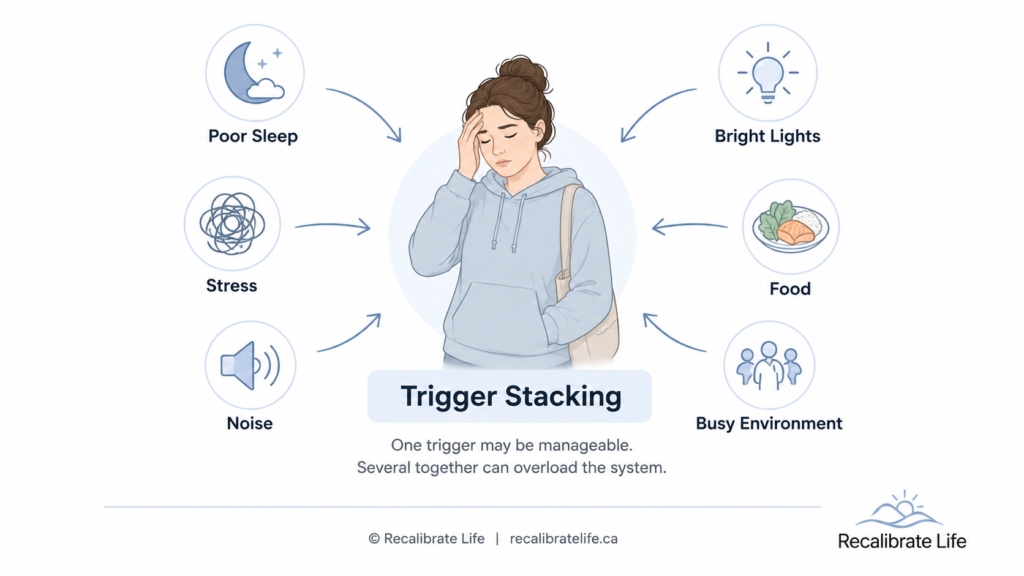
A flare is a temporary spike in symptoms triggered by something identifiable — or more often, a combination of somethings.
You stacked a few triggers without realizing it. Poor sleep the night before. A trigger meal at lunch. A bright, noisy environment in the afternoon. Each one was manageable alone. Together, they pushed your system past its threshold.
The result: symptoms spike. More imbalance than usual. Heavier brain fog. Increased sensitivity to everything. Anxiety kicks in. It feels like you’re right back where you started.
But here’s the key — underneath the spike, your baseline is still there. You can still feel it if you pay attention. The flare is loud, but it’s sitting on top of a foundation that hasn’t actually moved.
Most of my bad days have been flares. When I look back at what happened — poor sleep, a heavy meal, too much time in a stimulating environment, pushing too hard on a good day — the cause is almost always traceable. The system got overloaded. It didn’t get damaged.
And when I respond correctly — reduce stimulation, sleep well, hydrate, eat clean, stop pushing — the flare settles. Usually within a day or two. Sometimes within hours.

If tracking symptoms, triggers, medications, appointments, and recovery progress feels scattered, I created a Vestibular Migraine Recovery Planner to keep those details organized in one place.
What a setback actually feels like
A setback is different. It’s not a spike on top of your baseline — it’s the baseline itself shifting.
I experienced my clearest setback in those first months after my symptoms started. I kept pushing through, eating trigger foods without knowing they were triggers, sleeping inconsistently, and ignoring the signals my body was sending. The result wasn’t a temporary spike that settled with rest. The result was my overall capacity declining over weeks.
The imbalance didn’t just come and go. It stayed. The drowsiness was constant. The sensitivity to environments deepened. Things that were manageable in week one became overwhelming by week four. My baseline itself had worsened — not temporarily, but for an extended period.
A setback feels deeper than a flare. It’s not “today is hard.” It’s “my normal has changed.” The symptoms don’t respond as quickly to rest and trigger management. The recovery feels slower and less certain. And emotionally, it carries a weight that flares don’t — because it challenges your belief that you’re moving forward.
The good news is that setbacks are less common than flares. Most bad days — the vast majority — are flares. Temporary overloads that settle when you reduce the load. True setbacks usually happen when you’ve been consistently pushing past your limits without adequate recovery for an extended period.
How to tell which one you’re in
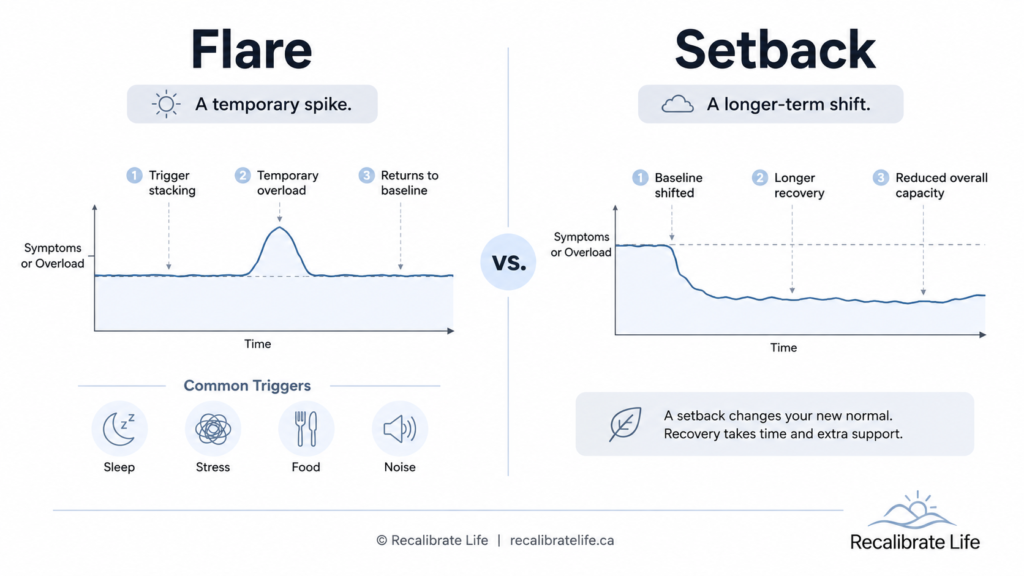
This is the practical part. When symptoms spike and you’re trying to figure out whether to worry or wait it out, here’s the framework I use.
Can you trace it back to triggers? If you can look at the past 24-48 hours and identify clear triggers — bad sleep, trigger food, overstimulating environment, stressful day, overdoing it on a good day — it’s almost certainly a flare. If you can’t find an obvious cause and the worsening seems to have come from nowhere, it might be something deeper.
Is your baseline still there underneath? During a flare, even though symptoms are elevated, you can usually still sense your normal baseline underneath the noise. It’s like turning up static on a radio — the signal is still there, just harder to hear. During a setback, the baseline itself feels different. Harder to find.
Does it improve with rest and reduced load? Flares respond to trigger management. Reduce stimulation, sleep well, eat clean, stop pushing — and within a day or two, things settle back. Setbacks are slower to respond. You do everything right and the improvement is gradual over weeks rather than days.
How long has it lasted? A flare typically resolves within hours to a few days. If you’ve been managing your triggers well and symptoms have persisted at a worsened level for weeks, that’s worth paying closer attention to.
What to do during a flare
When I recognize that I’m in a flare — not a setback — the approach is straightforward.
Stop adding load. The system is already overloaded. Don’t test it. Don’t push through. Don’t try to prove you’re fine. Reduce stimulation, reduce activity, reduce sensory input. Give your nervous system room to settle.
Prioritize sleep. Sleep is when your system recovers most effectively. After a flare, getting a solid 7-8 hours of consistent sleep is often the single fastest path back to baseline.
Simplify food. Eat clean, simple meals. No trigger foods, no heavy combinations, no experiments. Let your digestive system be one less thing your brain has to manage.
Hydrate aggressively. More water than usual. Dehydration extends flares. Hydration supports the recovery process.
Don’t analyze every sensation. This is the hard one. During a flare, the instinct is to monitor every symptom constantly — “is it getting worse? Is it the same? Am I improving?” That monitoring itself becomes a cognitive load that extends the flare. Observe, but don’t fixate. Note how you feel, then redirect your attention.
Wait. Most flares settle on their own once the load is reduced. Your job isn’t to fix it — it’s to stop making it worse and give your system the conditions it needs to self-correct.
What to do if it’s actually a setback
If symptoms persist beyond what a normal flare would explain — if your baseline has genuinely shifted and isn’t recovering with standard trigger management — the approach is different.
Talk to your healthcare team. A true setback might mean your treatment approach needs adjusting — medication changes, additional vestibular rehabilitation, or investigating whether something else is contributing.
Review your patterns over the past few weeks. Setbacks usually don’t appear out of nowhere. There’s often been a gradual accumulation — weeks of poor sleep, chronic stress, consistent trigger exposure, or pushing too hard for too long. Identifying that pattern helps you course-correct.
Be patient with a longer timeline. Flares resolve in days. Setbacks can take weeks to stabilize from. That’s frustrating, but knowing the timeline is longer helps you avoid the panic of expecting quick recovery and not getting it.
Don’t abandon what’s been working. During a setback, the temptation is to throw everything out — “nothing is working, why bother?” But the habits that built your progress are the same habits that will rebuild it. Keep the foundation. Adjust the details.
The emotional side nobody talks about
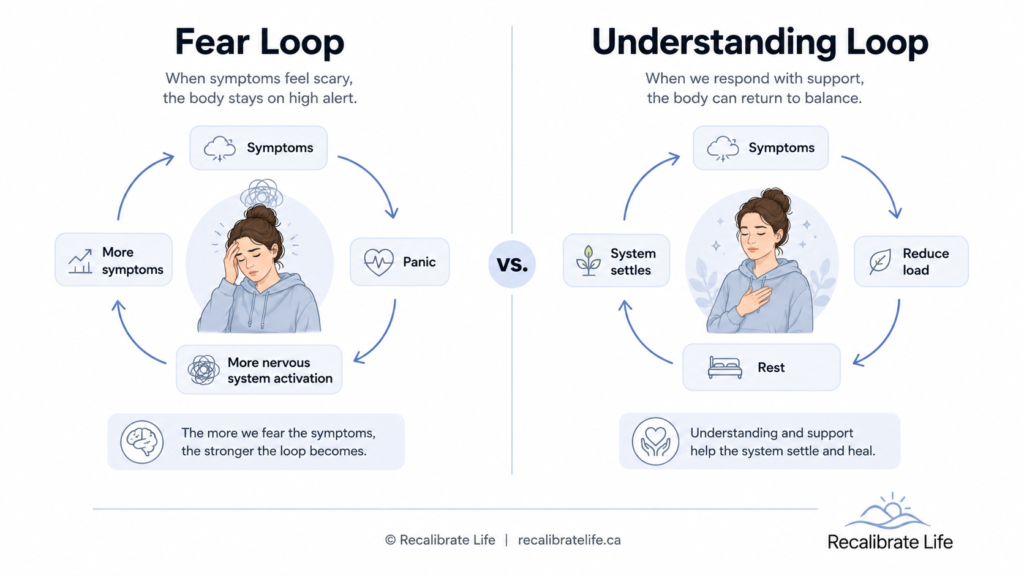
The hardest part of flares isn’t the symptoms. It’s the fear that they mean permanent damage.
After months of instability — of temporary improvements followed by crashes, of being told “you’ll get better soon” and watching that timeline stretch further — every bad day triggers a fear response that goes beyond the physical symptoms. The thought “what if this is permanent?” sits underneath every flare like a shadow.
And that fear becomes its own trigger. Panic increases nervous system activation. Nervous system activation increases vestibular symptoms. Vestibular symptoms increase panic. The loop feeds itself.
Learning to tell the difference between a flare and a setback was what finally interrupted that loop for me. When a bad day hits now, I don’t automatically catastrophize. I check my framework. I look at the triggers. I assess whether my baseline is still recognizable underneath. And most of the time, the answer is clear: this is a flare. It has a cause. It will settle.
I still don’t enjoy bad days. But I don’t interpret them as disaster anymore. And that’s a massive difference — because panic used to become another trigger, another layer of overload, another amplifier. Removing the panic doesn’t remove the flare. But it stops the flare from becoming something worse.
The realization that changed everything
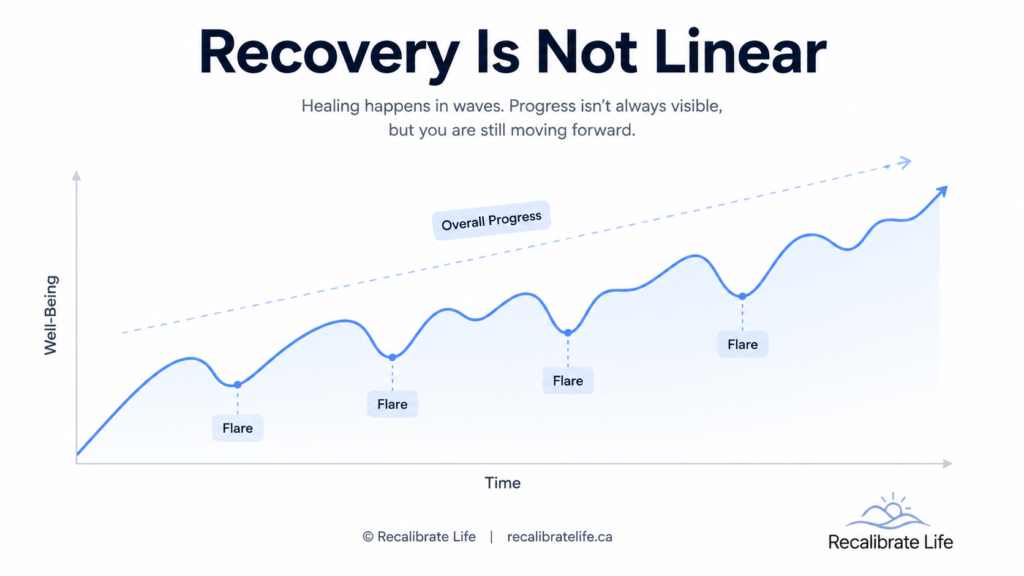
Recovery is not linear. I’ve written that in other posts and I’ll write it again because it took me months to emotionally accept it even after I intellectually understood it.
Good days don’t mean you’re cured. Bad days don’t mean you’ve lost all progress.
When I stopped measuring recovery day by day and started looking at trends over weeks, the picture changed completely. My good days were getting slightly better. My bad days were getting slightly less bad. My flares were becoming shorter and my recovery from them faster. Progress was happening — I just couldn’t see it through the noise of daily fluctuation.
A flare means your system got overloaded. A setback means your baseline changed for a while. Learning the difference was one of the biggest turning points in my recovery — not because it eliminated bad days, but because it gave me a way to understand them without fearing them.
And understanding without fear is where real management begins.
If you’re trying to track your flares, triggers, and baseline patterns, my free Vestibular Trigger Checklist includes a daily tracker that helps you see the difference between temporary spikes and real shifts. Drop your email and I’ll send it to you.
[Email signup form]
Related posts: