Yesterday was a good day. My head felt clearer than it had in weeks. I went for a 30-minute walk. I handled conversations without struggling. I ate a normal meal. For the first time in a long time, I thought: maybe I’m getting better.
Then I woke up the next morning and the fog was back. The dizziness was heavier. My balance felt uncertain again. It was like the progress from yesterday had been erased overnight.
If you’ve experienced this — the confusing, demoralizing cycle of good days followed by bad days — you’re not relapsing. You’re not getting worse. And it’s not random.
There’s a pattern behind it. And once you see it, the cycle becomes something you can actually manage.
In this post:
- The real reason good days lead to bad days
- The cycle explained (with a visual)
- Why your system responds with a delay
- How to break the pattern
- The mindset shift that changed everything
Short version for brain fog readers: Good days feel like recovery, so you do more. But your system isn’t fully recovered — it just has lower symptoms. Doing more uses capacity you don’t actually have yet. The crash the next day isn’t random — it’s your system processing the overload. The fix: pace yourself on good days instead of pushing to 100%.
The good day trap
Here’s what I didn’t understand for a long time: feeling better is not the same as being better.
On a good day, your symptoms are lower. Your brain fog lifts a little. Your balance feels more stable. And naturally, your instinct is to make the most of it. You walk more. You do more around the house. You eat more freely. You engage with things you’ve been avoiding. It feels like progress.
And in the moment, it is. Nothing crashes immediately. You get through the day feeling almost normal. You go to bed thinking you’ve turned a corner.
Then morning comes. And it’s worse than yesterday. Sometimes worse than the day before that. The fog is thick. The dizziness is heavier. Your baseline has dropped.
This isn’t a relapse. This is your system telling you that yesterday’s “good day” used more capacity than you actually had available.
The cycle — and why it’s not random
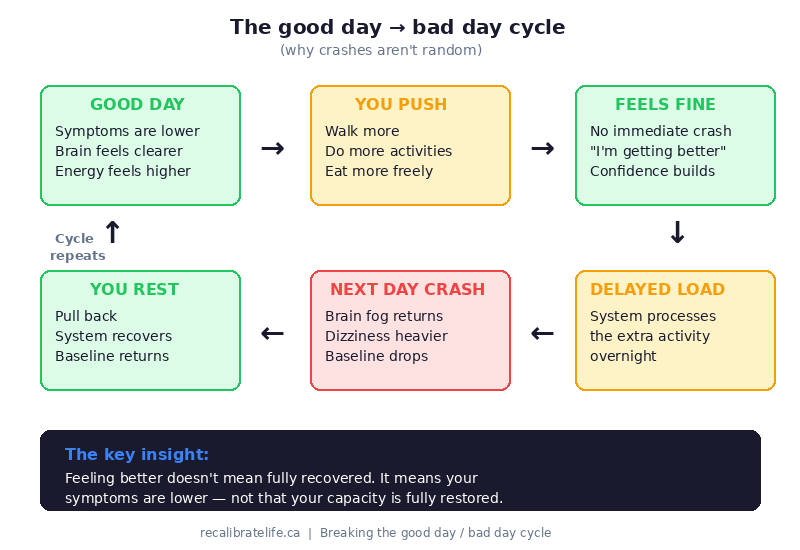
This cycle played out in my life over and over before I understood what was driving it.
Step 1: Good day. Symptoms are lower. Brain feels clearer. Energy feels higher. You feel more like yourself.
Step 2: You push. Because you feel better, you do more. Longer walks. More activities. More exposure to environments you’ve been avoiding. You eat more freely. You think more, plan more, engage more.
Step 3: Feels fine. Nothing crashes immediately. You don’t feel worse during the day. In fact, you feel encouraged. “I’m getting better,” you think. Confidence builds.
Step 4: Delayed load. Here’s what’s happening underneath the surface — your system is processing all that extra activity, but the bill hasn’t come due yet. Your nervous system handles the load during the day, but the cumulative impact builds quietly.
Step 5: Next day crash. You wake up and the brain fog is back. Dizziness is heavier. Balance feels off. Your baseline has dropped — not because you did something “wrong,” but because your system exceeded its actual capacity yesterday, and today is the payback.
Step 6: You rest. You pull back. Reduce activity. Give your system time to recover. Baseline gradually returns. And then — another good day arrives. And the cycle tempts you to push again.
The key to breaking this cycle is understanding one thing: your worst days don’t come out of nowhere. They’re often the result of what you did on your best days.
Why your system responds with a delay
This is the part that makes the pattern so confusing. If you overdid it and crashed immediately, you’d learn the lesson fast. But vestibular migraine doesn’t work that way.
Your nervous system has a delayed response to overload. You can push through a full, active day and feel fine the entire time. Your brain handles it — but it’s using reserves it doesn’t actually have. The processing happens overnight or over the following hours, and that’s when the crash comes.
Think of it like a credit card. You can spend more than you have today, and nothing happens immediately. But the bill arrives tomorrow. With vestibular migraine, good days are your credit limit — and pushing too hard is spending beyond it.
This delay is also why it’s so hard to connect the cause to the effect. You wake up feeling terrible and think “what did I do wrong today?” when the real answer is what you did yesterday. Once I started looking back 24 hours instead of analyzing the current day, the patterns became obvious.
What actually causes the next-day crash
Through tracking and paying attention, I identified the specific things that consistently led to crashes after good days.
Overdoing physical activity was the most common trigger. A good day would make me feel like I could handle a longer walk, more chores, or a trip to the gym. And in the moment, I could. But the next day, my system would respond as if I’d overloaded it — because I had. The activity itself wasn’t harmful. The amount was more than my current capacity could sustain.
Combined triggers adding up silently. On a good day, I’d be more active, eat more freely, spend more time in stimulating environments, and mentally engage more with planning and thinking. Each one individually was fine. But together, they created a cumulative load that my system processed overnight.
Sleep inconsistency amplified the crash. A good day might lead to staying up later — feeling good, watching something, being more active in the evening. That shift in sleep schedule, even by an hour, could make the next morning’s fog noticeably worse.
The psychological factor. On good days, there’s an urgency to “make up for lost time.” You want to do everything you couldn’t do on bad days. That urgency pushes you past your actual limits because the motivation feels like capacity — but it’s not. Feeling motivated doesn’t mean your system has more bandwidth.
How to break the cycle
Breaking this pattern doesn’t mean avoiding good days or refusing to do anything when you feel better. It means pacing — using your good days strategically instead of spending all your capacity at once.
Use 70%, not 100%. On a good day, your instinct is to go all in. Resist that. Do 70% of what you feel capable of. If you think you can walk for 40 minutes, walk for 25. If you feel like you could handle a full shopping trip, do a shorter one. Leaving capacity in reserve is what prevents the next-day crash.
Keep your routine consistent. Good days tempt you to break routine — stay up later, eat differently, do more. But consistency is what your vestibular system needs most. Same sleep schedule. Same meal patterns. Same activity levels. A good day with a consistent routine is much less likely to produce a crash than a good day where you change everything.
Track backwards. When you have a bad day, don’t just look at what’s happening today. Look at yesterday. What did you do? How active were you? What did you eat? How late did you stay up? The cause is almost always 12-24 hours behind the symptom. Once you start tracking backwards, the “random” bad days stop being random.
Pace your exposure. If you’ve been avoiding a certain environment — a store, a social setting, a busy place — and you feel good enough to try it, go. But keep it short. A 15-minute controlled exposure on a good day is more productive than a 45-minute marathon that crashes you for two days. Gradual exposure works. Overexposure sets you back.
Celebrate without overcorrecting. A good day is genuinely worth appreciating. But appreciate it by maintaining what got you there — not by throwing out the system that produced it. The habits that created the good day are the same habits that will create the next one.
The mindset shift that changed everything
For months, I treated good days and bad days as evidence of whether I was getting better or worse. A good day meant progress. A bad day meant regression. Every fluctuation felt like a verdict on my recovery.
The shift that changed everything was realizing that individual days don’t tell you anything meaningful. Trends over weeks do.
When I zoomed out and looked at my patterns over two or three weeks instead of day to day, I could see that my good days were getting slightly better, my bad days were getting slightly less bad, and the crashes were becoming shorter and less severe. Progress was happening — I just couldn’t see it when I was measuring day by day.
Feeling good doesn’t mean fully recovered. It means your symptoms are lower that day. Your capacity hasn’t suddenly doubled. Your threshold hasn’t permanently risen. You’re having a good day within a system that’s still healing — and respecting that is what keeps the good days coming more often.
You are not random. You are not regressing. You are learning your system’s limits. And every time you pace a good day instead of burning through it, you’re building a more stable baseline that produces more good days with fewer crashes.
That’s not a setback. That’s recalibration.
If you’re trying to track your triggers and patterns — including what leads to good days and bad days — I’ve put together a free Vestibular Trigger Checklist with a daily tracker built in. Drop your email and I’ll send it to you.
Related posts: